Rosy Apple Aphid (Dysaphis plantaginea)
Authors: Evan Lentz, Michael Fenton, Lauren Kurtz
Evan.lentz@uconn.edu
Reviewers: Shuresh Ghimire & Mary Concklin, UConn Extension
Publication EXT198 | March 2026
Introduction
Apple and pear trees are the primary hosts for the Rosy Apple Aphid. The varieties ‘Cortland’, ‘Ida Red’, and ‘Golden Delicious’ are particularly susceptible. Alternate hosts for this pest include herbaceous plantains and docks.
Description and Life Cycle
Rosy Apple Aphid (RAA), Dysaphis plantaginea (Passeri), an early season pest of apples and pears, overwinters as eggs laid on stems and bark of host trees. Pest emergence begins in early April, as overwintering eggs begin to hatch. Newly hatched nymphs feed on developing buds and then migrate to developing leaves as they expand.
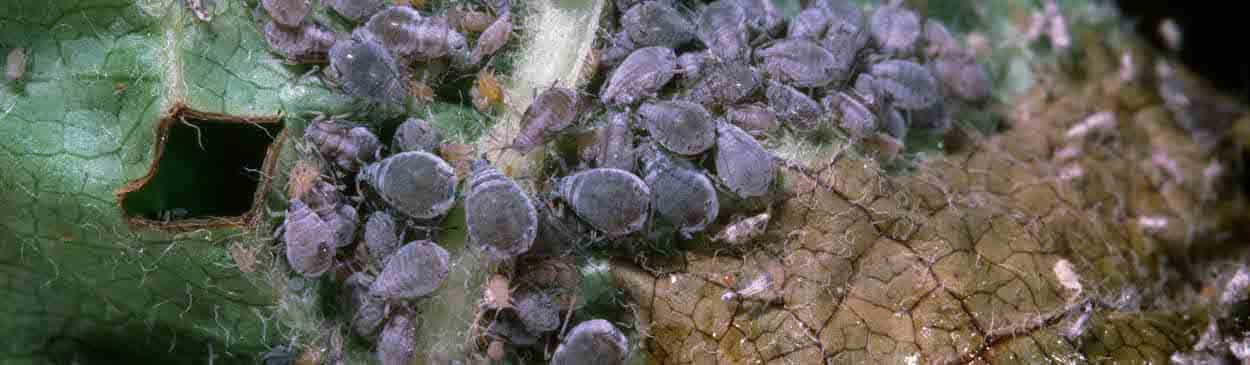
As first-generation nymphs reach reproductive maturity, females, called ‘stem mothers’ give birth to live young, through the process of parthenogenesis, to form colonies (Figure 1). Parthenogenesis is the process of reproduction without fertilization, common in aphids.
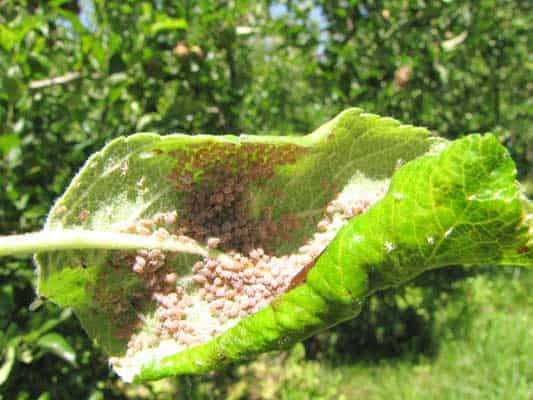
Nymphs remain close to the birthing mother and feed on leaf tissues. Toxins in the aphids’ saliva cause leaves to curl over at feeding sites, usually the underside of leaves (Figure 2). The curled leaves provide protection from natural predators, the environment, and insecticides, making early detection and control measures essential. Feeding sites will often harbor other aphid species although the RAA’s distinct rosy coloring should allow for differentiation.
The second generation of RAA usually appears two to three weeks post-petal fall. Throughout the spring, populations swell as females continue to give birth, and aphids migrate from leaf to leaf. RAAs progress through five nymphal stages before reaching maturity within two to three weeks. As a result, RAA colonies produce and leave behind small masses of exoskeletons and a characteristic honeydew that promotes the growth of sooty mold.
In early summer, winged adult RAAs begin to develop and migrate off infested host trees to one of their herbaceous alternative hosts, such as broadleaf plantain, narrowleaf plantain, and dock. On the alternate host, winged adults will reproduce asexually, producing additional generations of wingless adults.
In the fall, newly developed winged adults return to the primary host. Here, egg-laying females will mate with male aphids. RAA females will lay their fertilized eggs in hidden, creviced areas on the host tree, often around buds. However, recent research has suggested that RAAs may not need to migrate to alternate hosts and are instead able to complete their life cycle solely on their primary host.
Identification
Eggs: RAA eggs are a creamy yellow color which slowly transitions to a shiny black in the winter. Egg masses can be found on the stems, at the base of spurs, and on buds throughout the hosts’ dormant season. Eggs are one-half mm long and football-shaped. However, locating RAA eggs are not an effective way to identify or monitor this pest due to their likeness to other insect eggs.
Stem Mothers: Stem mothers are relatively large compared to nymphs and adults, with a rounded body and a thick white coating, making them appear grayer than the later rosy, purple-colored generations, and black antenna.
Nymphs: There are five nymphal stages which vary in size and color. Early nymphs are tan with a shiny, wet appearance and slowly transition to their characteristic rosy brown/purple color over time.
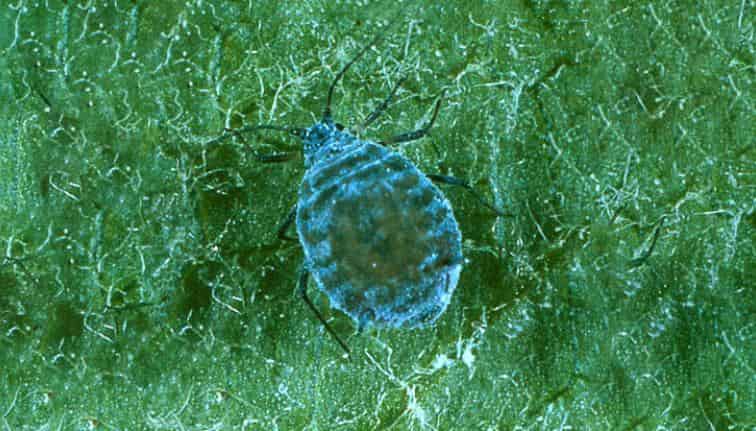
Adults: Wingless RAA adults are smaller and more purple than birthing females (Figure 3). Winged adults that migrate have dark brown/green bodies, a black head, a black thorax, and clear wings that develop one at a time. Adults are about 2.5 mm long.
Damage
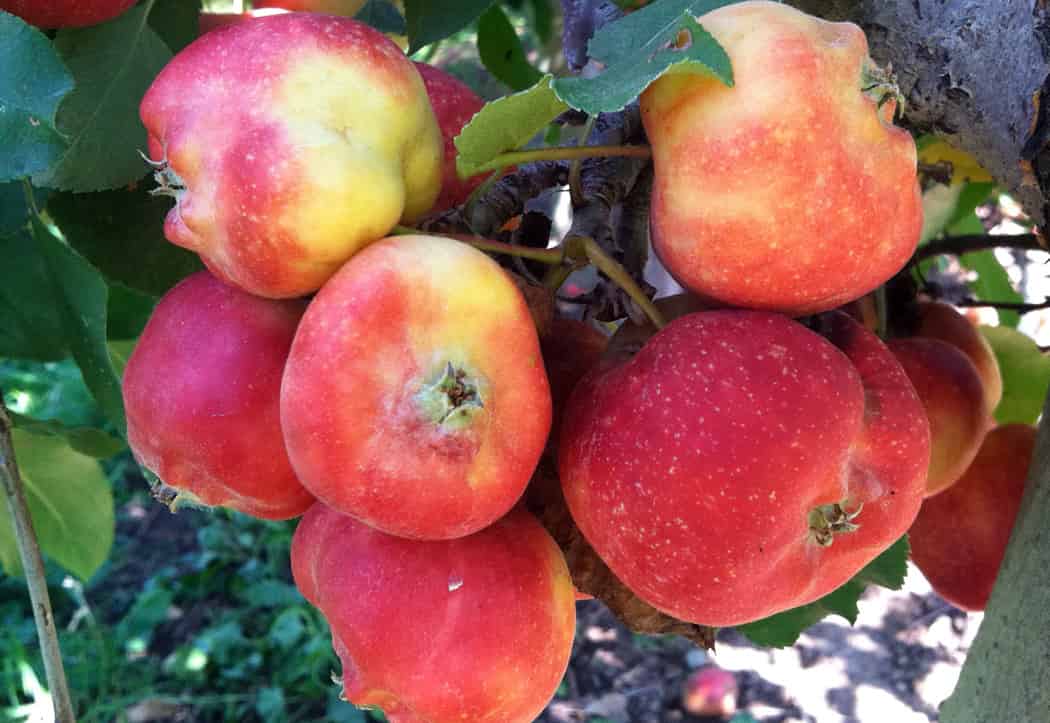
Aphids utilize their piercing and sucking mouthparts to break into plant cells and tissues to extract sap and nutrients. This feeding can cause chlorosis and eventually necrosis. While feeding, RAA releases a toxin that causes deformation of leaves and developing fruit (Figure 2 & Figure 4). Damaged leaves often exhibit a contorted, puckered, or curled appearance. Damaged fruit typically exhibits puckering towards the calyx end. As the fruit develops, damaged tissues become lumpy, asymmetrical, and rigid (Figure 4).
Additionally, aphid feeding sites provide entry points for other pathogens, effectively increasing the risk period past the bloom period of host trees. An additional secondary infection risk arises from the RAA colonies’ production of honeydew, which promotes the growth of sooty mold on developing fruit.
Monitoring
Early scouting and identification of rosy apple aphids are integral to effective chemical control of the pest. Aphid eggs can be scouted for before or during early pink. Begin scouting on early season varieties at highest risk of economic damage occurring like Golden Delicious, Cortland, and Empire. By selecting five to 10 trees for every block, take at least three minutes, and count each fruit spur showing curled leaves. If the average is more than one curled cluster per tree, an insecticide spray is economically and productively justifiable.
Growers should be scouting closer to the inside and high parts of trees as this is where they are most likely to first appear. Looking for curled and deformed fruit is another major indicator that growers should be on the lookout for throughout the season.
Management
The best chance growers have at controlling rosy apple aphid populations chemically is by applying sprays early in the season. Insecticidal soap at concentrations ranging between one and two percent, or organophosphate insecticides, are the most effective when it comes to control of early season RAA.
Pesticides with a systemic mode of action are the most effective. Insecticides with the active ingredient spirotetramat are effective at restricting development and reproduction of RAA. This ingredient is slightly harmful or harmless to beneficial insects, depending on the degree day it is sprayed and the population of the beneficials in the area.
Remove secondary hosts around the area (such as broadleaf plantain and dock) as these harbor the aphids during the summer. Removing these resources disrupts the aphid’s natural cycle and can prevent new winged adults from migrating back to apple trees.
Resources
Krawczyk G. 2023. Tree fruit insect pest – Rosy apple aphid. Penn State Extension. Accessed 5 Feb 2026. https://extension.psu.edu/tree-fruit-insect-pest-rosy-apple-aphid.
Piñero J. Aphid: Rosy apple aphid. New England Tree Fruit Management Guide. Accessed 5 Feb 2026. https://netreefruit.org/apples/insects/aphid-rosy-apple-aphid.
Rivera M, Basedow M, & van Zoeren J. 2022. Rosy apple aphid (Dysaphis plantaginea). Cornell Integrated Pest Management Program. Accessed 5 Feb 2026. https://cals.cornell.edu/integrated-pest-management/outreach-education/fact-sheets/rosy-apple-aphid-dysaphis-plantaginea.
The information in this document is for educational purposes only. The recommendations contained are based on the best available knowledge at the time of publication. Any reference to commercial products, trade or brand names is for information only, and no endorsement or approval is intended. UConn Extension does not guarantee or warrant the standard of any product referenced or imply approval of the product to the exclusion of others which also may be available. The University of Connecticut, UConn Extension, College of Agriculture, Health and Natural Resources is an equal opportunity program provider and employer.