How to Get Started with Composting at Home: A Practical Guide

Authors: Avishesh Neupane
dpj25003@uconn.edu

Reviewers: Dawn Petinelli

Publication EXT206 | April 2026

DOI Pending

Introduction

Connecticut households, it can help reduce trash, make use of the large amount of fall leaves that many properties produce, and turn common yard and kitchen materials into a valuable soil amendment.

Finished compost can be used in many places, including vegetable gardens, flower beds, around trees and shrubs, and even in containers or potted plants as part of the growing mix to enhance plant growth.

Compost adds organic matter, supplies nutrients, boosts water-holding capacity in sandy soils, and can make heavier soils easier to work with. Home composting is often easier than people think, and even a basic backyard setup can work well and provide real benefits. For most households, the best place to start is with a simple system that is easy to manage.

What to add to the compost pile

Good compost piles rely on a mix of carbon-rich ‘browns’ and nitrogen-rich ‘greens’ materials.

Greens include fruit and vegetable scraps, coffee grounds, paper tea bags without staples, fresh plant trimmings, and limited amounts of grass clippings.

Browns include dry leaves, straw, shredded paper, shredded cardboard, untreated wood shavings, and small twigs. In Connecticut, dry leaves are often the most useful brown material because they are abundant, easy to store, and especially helpful for balancing the pile with food scraps.

Usually suitable for a backyard pile

• Fruit and vegetable scraps
• Coffee grounds and paper filters
• Paper tea bags without staples
• Eggshells
• Leaves and garden debris
• Fresh plant trimmings and spent flowers
• Small amounts of grass clippings mixed with leaves
• Shredded paper and cardboard
• Small twigs and untreated wood shavings

Usually best kept out

• Meat, fish, bones, and dairy
• Fats, oils, and greasy foods
• Pet waste or cat litter
• Large amounts of cooked food
• Diseased plants, unless you know the pile will heat thoroughly
• Aggressive weeds with mature seed
• Pressure-treated wood, charcoal ash, or glossy paper

Choosing a composting system

Many people can get started composting with a simple system that fits their space and needs. A wire bin, a simple wooden bin, a commercial plastic bin, or even a small open pile can all work well. The best choice depends on available space, appearance considerations, cost, and the amount of material you expect to handle.

For small suburban lots, an enclosed bin often looks tidier, uses space efficiently, and helps retain heat and moisture. For larger yards with heavy leaf volume or more garden debris, a simple holding bin or multi-bin system is often easier to manage and better suited for larger amounts of material.

Place the pile in a convenient, well-drained location with access to water. A spot that is easy to reach year-round is usually more important than finding the ideal amount of sun, since backyard piles can work in either sun or shade if moisture is managed properly. Composting can take as much attention, or as little attention, as you have to give to it. The material will decompose but just not as fast if not regularly turned.
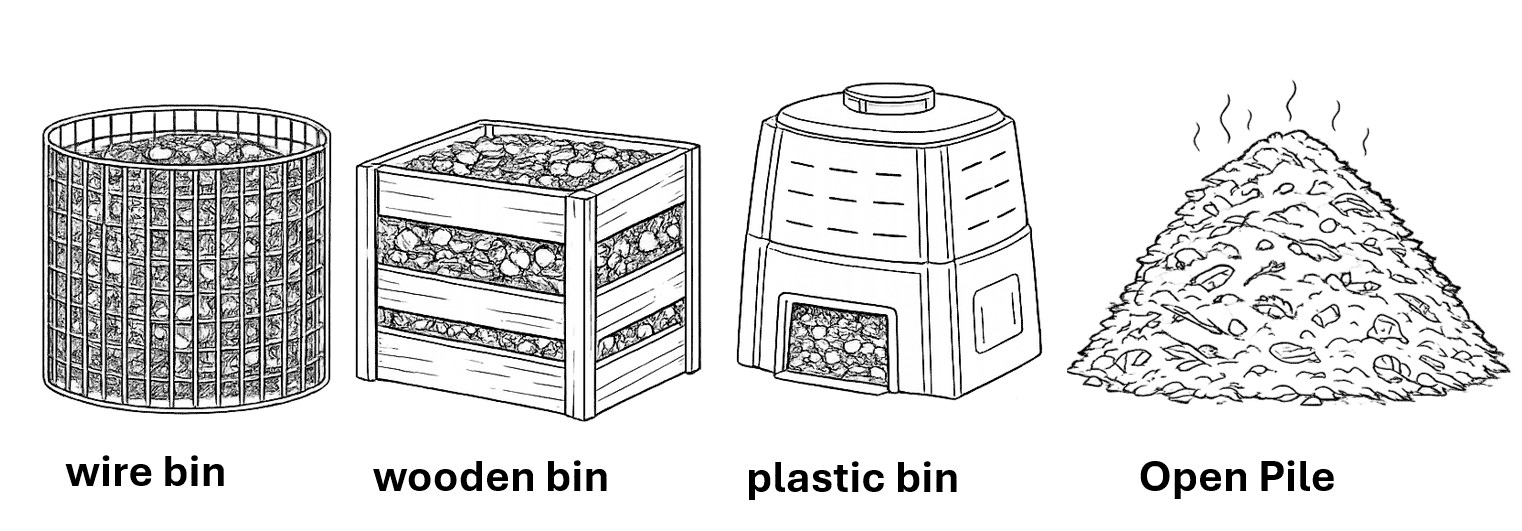
illustration of different types of compost bins, wire bin, wooden bin, plastic bin, and open pile.
Fig. 1. Common backyard composting systems: wire bin, wooden bin, plastic bin, and open pile.

Building and managing the pile

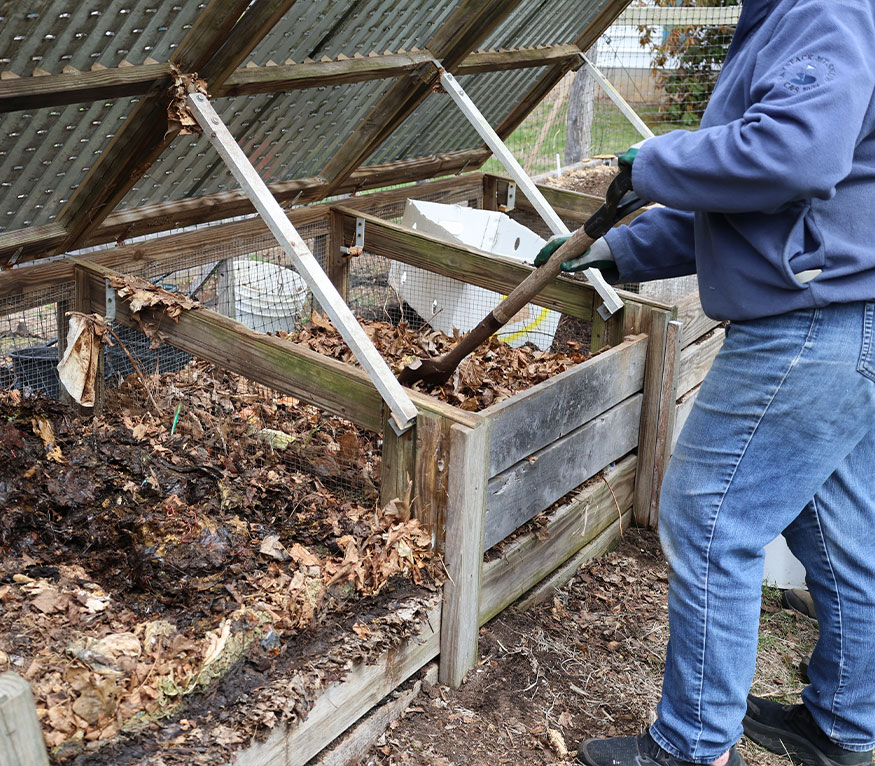
A person turning their compost pile with a shovel.

Start with a loose base of coarse browns, such as twigs or coarse stems, to improve airflow. Then add materials in thin layers or small batches. Each time you add food scraps or fresh greens, cover them with dry leaves or another brown material. Many households find that keeping a separate bag or bin of stored leaves or other browns nearby is the easiest way to keep the pile balanced.

If the pile becomes too dry, decomposition slows down. If it becomes too wet, it can start to smell. The materials should feel about as damp as a wrung-out sponge, moist but not soggy.

Turn or mix the pile when it smells sour, stays very wet, or becomes matted. A compost turning tool or garden fork can help with this. Turning helps bring air into the pile and usually speeds up the breakdown. The composting process is driven by many living organisms that break down organic materials. These include bacteria, fungi, worms, insects, and other small soil-dwelling organisms. Keeping the pile loose and occasionally turning it helps maintain the conditions they need to keep working.

As compost breaks down, the pile may become warm, especially when it has a good mix of materials, enough moisture, and enough air. This heating is a normal part of active decomposition and can help the pile break down faster. Still, many backyard piles never get very hot, and that does not mean composting has failed. A cooler pile can still make good compost, although it will usually take longer.

Do not worry if the pile slows during winter. Composting continues as long as microbes have food, moisture, and some air, but the process is much slower in cold weather. You can keep adding materials through winter, cover them well with leaves, and let the pile reactivate in spring.

Avoiding odors, rodents, and other common problems

Most home compost problems have simple causes. Bad odors usually mean the pile is too wet, too compacted, or overloaded with nitrogen-rich material. Rodents are more likely when food scraps are exposed or when unsuitable items such as meat or dairy are added. Keeping scraps covered with leaves or other brown material is one of the most effective ways to prevent both odor and pests.

A common mistake is adding too many grass clippings or food scraps without enough dry leaves or other brown materials. Grass clippings should not be added in thick layers because they can mat together and become slimy or odorous. In most cases, the pile should contain noticeably more brown materials than green materials.


Problem Likely Cause What to Do
Pile smells rotten Too wet or too many greens Add dry leaves, loosen the pile, and turn it.
Pile does not heat Too dry, too small, or not enough nitrogen Moisten lightly, mix materials, and add a small amount of fresh green material.
Rodents or raccoons Food scraps are exposed, or unsuitable materials were added Stop adding meat, dairy, and greasy food; bury or cover scraps immediately.
Slimy grass layer Too much fresh grass at once Mix clippings with leaves and avoid thick layers.


If you do not want to manage food scraps at home, yard-waste-only composting is still worthwhile. In Connecticut, many towns offer food-scrap drop-off options, and in some areas curbside collection may also be available.

When is compost ready and how to use it

Finished compost is dark, crumbly, and earthy-smelling. You should not see many recognizable food scraps, and the pile should no longer be actively heating. A curing period after the active phase helps the compost stabilize before use. Depending on the season and how the pile is managed, compost may be ready in a few months, although many backyard piles take six months to a year or longer. In the warm season, a tumbler or drum composter that is turned daily may produce small amounts of finished compost in as little as one to two months.

Use compost as a soil amendment, not as a complete soil substitute. In most home gardens, it is better to mix a modest amount into the top several inches of soil or use it as a surface mulch than to grow directly in pure compost. Repeated heavy applications can lead to nutrient buildup, excess salts, or imbalanced soils, especially where manure-based composts are used regularly.

In Connecticut vegetable gardens, compost works best when paired with a soil test. This helps guide pH and nutrient management, especially in gardens that receive compost year after year.

Special situations and common questions

Residents with very limited outdoor space may prefer a small enclosed bin, yard-waste-only composting, or vermicomposting. Vermicomposting uses composting worms in a covered bin to break down food scraps into compost. It can be a practical option for apartments, condominiums, and other homes where a full outdoor pile is not realistic.

Worm bins work best with many fruit and vegetable scraps, coffee grounds, and other small amounts of soft plant-based kitchen materials. They are typically kept in sheltered indoor spaces, such as under kitchen sinks and basements, where temperatures remain moderate. Like backyard piles, worm bins should not receive meat, dairy products, oily foods, or large amounts of very wet materials.

No matter which composting method you use, it is important to be cautious with weeds and plant diseases. Many backyard systems do not stay hot enough long enough to reliably kill all weed seeds or plant pathogens. If you are unsure, leave those materials out of the pile or send them through a municipal option if one is available.

A simple routine works best for most households:

  • save leaves in fall;
  • keep a kitchen pail for scraps;
  • cover each addition with browns;
  • turn the pile whenever it becomes wet, compacted, or slow to break down.

Keep the system simple enough that you will use it year-round. A manageable pile is better than an ambitious system that becomes too much work and a nuisance.

A simple, consistent system is usually enough to make composting worthwhile. The goal is a system that fits your property and that you can maintain consistently.

Where to find help in Connecticut

For Connecticut-specific guidance on backyard composting and compost use in gardens, start with UConn Extension and CT DEEP.

UConn’s Home and Garden Education Center can help with home gardening questions, and the UConn Soil Nutrient Analysis Laboratory can help with soil testing if you plan to use compost regularly in vegetable gardens or around landscape plants.

For current food-scrap drop-off sites, organics collection options, or town compost bin programs, check with your municipal recycling coordinator, transfer station, or CT DEEP resources, since these services vary by community.


Resources

Connecticut Department of Energy and Environmental Protection (CT DEEP). Home Composting: Turn Your Spoils into Soil. https://portal.ct.gov/DEEP/Waste-Management-and-Disposal/Organics-Recycling/Home-Composting---Turn-Your-Spoils-into-Soil

UConn Soil Nutrient Analysis Laboratory. Backyard Composting. https://soiltesting.cahnr.uconn.edu/backyard-composting/

U.S. Environmental Protection Agency. Composting at Home. https://www.epa.gov/recycle/composting-home

UConn Soil Nutrient Analysis Laboratory. Selecting a Backyard Compost Bin. https://soiltesting.cahnr.uconn.edu/selecting-a-backyard-compost-bin/

UConn Soil Nutrient Analysis Laboratory. Making Compost Using a Stationary Plastic Compost Bin. https://soiltesting.cahnr.uconn.edu/making-compost-using-a-stationary-plastic-compost-bin/

UConn Soil Nutrient Analysis Laboratory. Compost Troubleshooting Guide. https://soiltesting.cahnr.uconn.edu/compost-troubleshooting-guide/

UConn Soil Nutrient Analysis Laboratory. Compost, Compost Tea, and Manure: Food Safety Implications in the Vegetable Garden. https://soiltesting.cahnr.uconn.edu/compost_compost_tea_and_manure/

Connecticut Department of Energy and Environmental Protection (CT DEEP). What Do I Do With...? Food Scraps. https://portal.ct.gov/DEEP/Waste-Management-and-Disposal/What-Do-I-Do-With

Connecticut Department of Energy and Environmental Protection (CT DEEP). Do Not Trash Grass. https://portal.ct.gov/deep/waste-management-and-disposal/organics-recycling/do-not-trash-grass

UConn Home and Garden Education Center. Garden Beds. https://homegarden.cahnr.uconn.edu/factsheets/garden-beds/

USDA Natural Resources Conservation Service. National Engineering Handbook, Part 637, Chapter 2: Composting. https://directives.nrcs.usda.gov/sites/default/files2/1720464003/Chapter%202%20-%20Composting.pdf

University of Minnesota Extension. Composting in Home Gardens. https://extension.umn.edu/managing-soil-and-nutrients/composting-home-gardens

University of Minnesota Extension. How to Correct Problems Caused by Using Too Much Compost and Manure. https://extension.umn.edu/nutrient-management-specialty-crops/correct-too-much-compost-and-manure

U.S. Environmental Protection Agency. Approaches to Composting. https://www.epa.gov/sustainable-management-food/approaches-composting

The information in this document is for educational purposes only. The recommendations contained are based on the best available knowledge at the time of publication. Any reference to commercial products, trade or brand names is for information only, and no endorsement or approval is intended. UConn Extension does not guarantee or warrant the standard of any product referenced or imply approval of the product to the exclusion of others which also may be available. The University of Connecticut, UConn Extension, College of Agriculture, Health and Natural Resources is an equal opportunity program provider and employer.