Beech Bark Disease
Author: Pamm Cooper
pamela.cooper@uconn.edu
Reviewer: Lauren Kurtz, UConn Extension
Publication EXT193 | January 2026
Introduction
Beech bark disease (BBD) is a serious disease of native American and non-native European beech trees, caused by the feeding of the non-native felted beech scale, Cryptococcus fagisuga. The feeding pierces the bark, which provides an opening for subsequent infection by the native fungal pathogens Neonectria ditissima, and N. faginata.
Signs and Symptoms of Infection
The felted scale insects exudes a waxy covering on their bodies, which is why tree trunks with high populations of scale often appear whitewashed. Look for this scale from late spring to summer.
The legless female adults pierce the surface of the bark to feed on the phloem, thus creating points of entry for the fungal pathogens to infect the tree via infection of the phloem and xylem, forming the disease’s characteristic cankers.
Infection of adult beech, and the proliferation of BBD cankers, results over time in pockmarked bark and, in more severe cases, contorted stems of infected trees not killed. Scale insects are less likely to attack phenotypes of beech that have rough bark, preferring beech trees with the familiar smooth, thinner, gray bark.
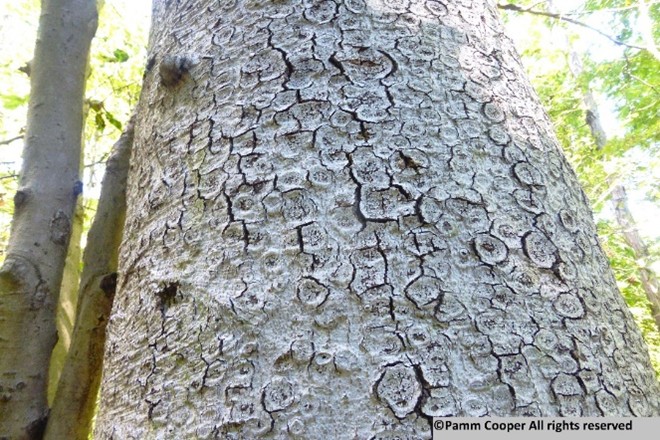
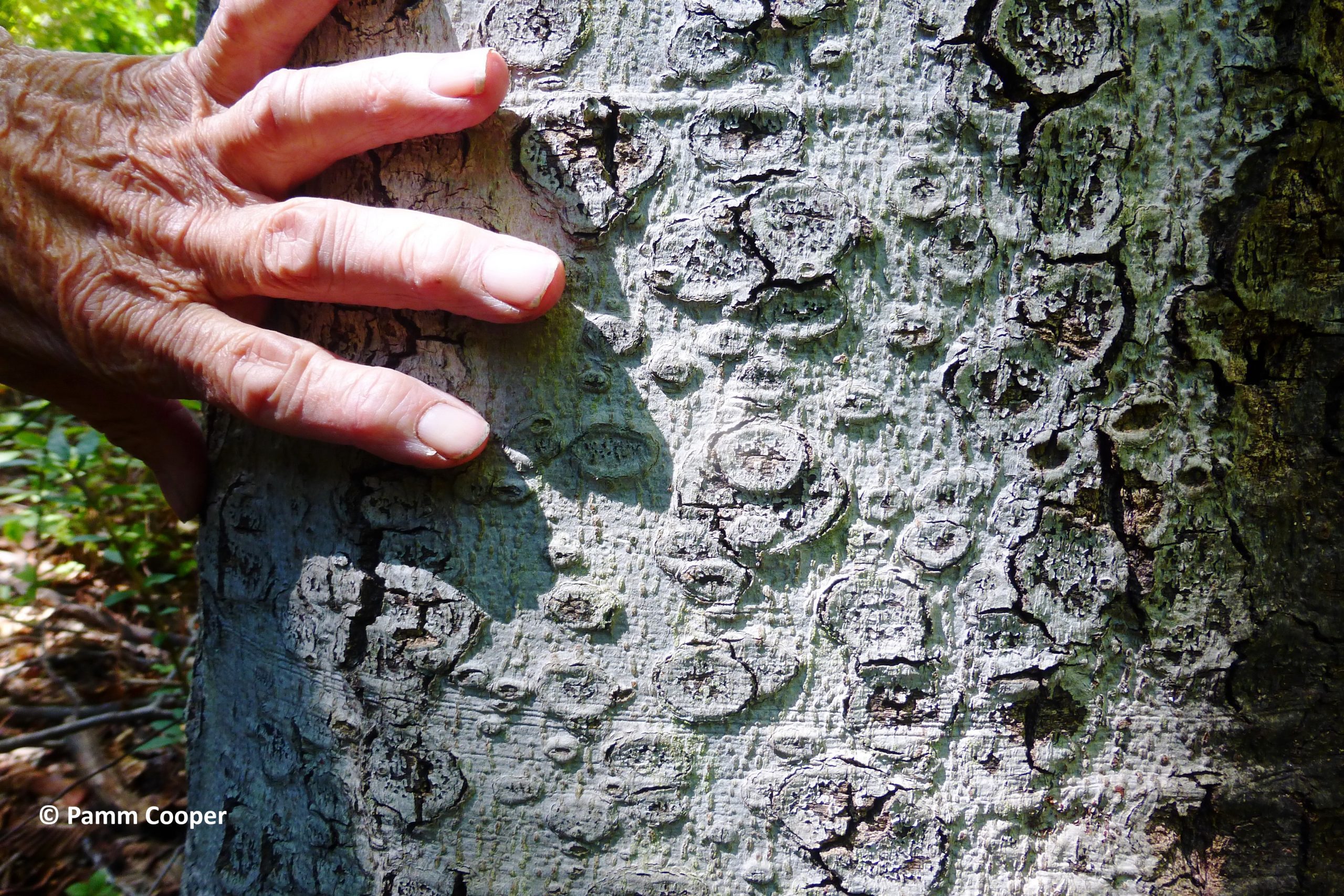
Pock marked bark caused by BBD pathogens on mature smooth-barked beech
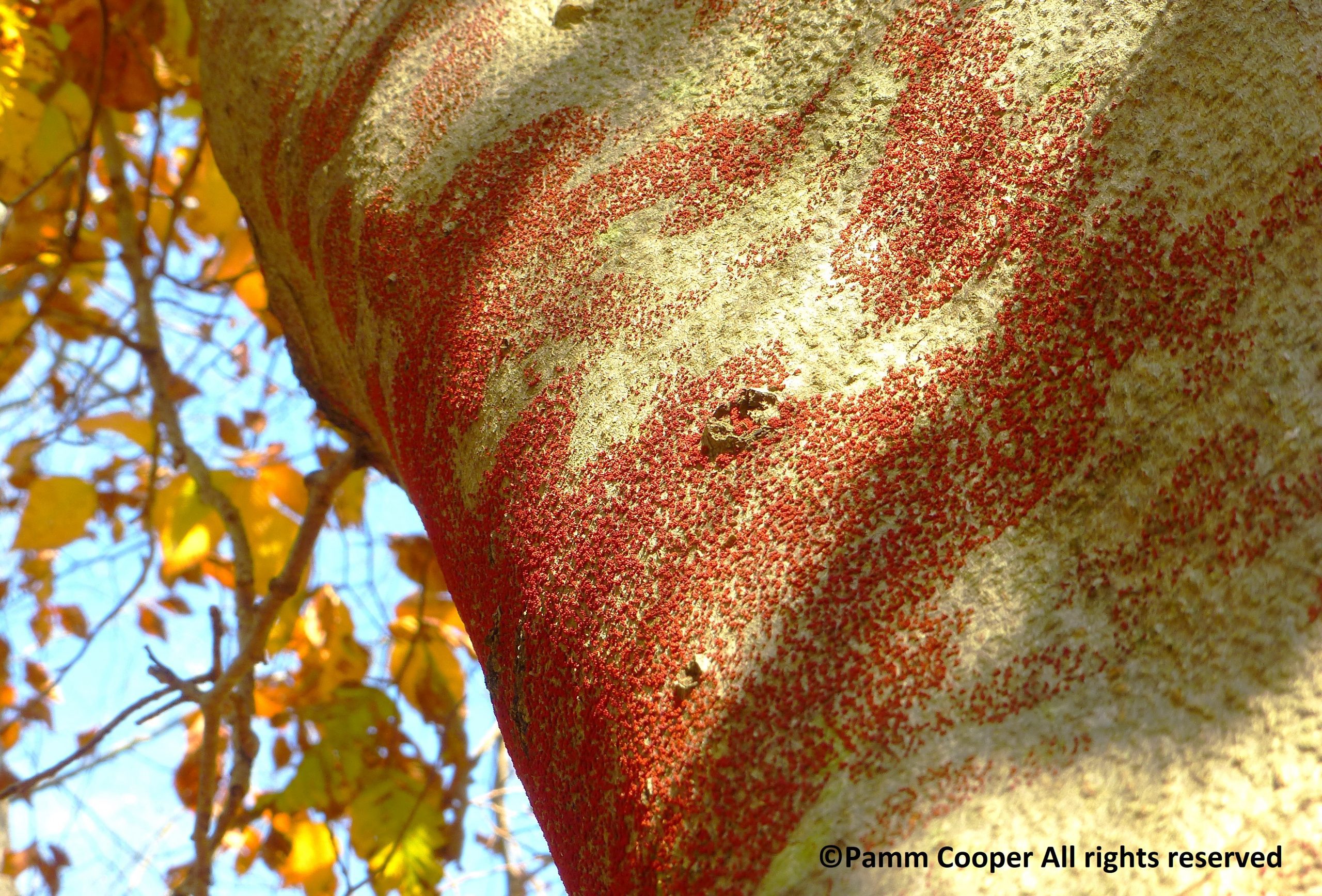
Signs of fungal infection include masses of red perithecia (the sexual spore-bearing structures of both Neonectria species) on the trunk of infected beech trees. These may be mistaken for slime mold fruiting bodies. Bark deformities and cankers are also signs of infection. Often, circular raised pock-marked formations in the callus cover the trunk.
Management
Homeowners with a few high valued beech trees may be able to treat trees for the fungal pathogens. There are no methods of scale control that are practical in home landscape settings. Unfortunately, trees in the wild have little chance of any treatment.
Other Insights
There may be an interaction between the scale and the Neonectria fungi which may lead to decline in the severity and the occurrence of BBD. There may be small pockets of healthy trees in forested areas where rough barked trees, previously infected, are now healthy and free from scale populations.
Resources
Maine Forest Service. (2024). Beech bark disease (Cryptococcus fagisuga and Neonectria spp.)
https://www.maine.gov/dacf/mfs/forest_health/documents/beech_bark_disease.pdf
University of New Hampshire. (n.d.). Examining beech bark disease: Fungal pathogens and bark responses.https://colsa.unh.edu/resource/examining-beech-bark-disease-fungal-pathogens-bark-responses
The information in this document is for educational purposes only. The recommendations contained are based on the best available knowledge at the time of publication. Any reference to commercial products, trade or brand names is for information only, and no endorsement or approval is intended. UConn Extension does not guarantee or warrant the standard of any product referenced or imply approval of the product to the exclusion of others which also may be available. The University of Connecticut, UConn Extension, College of Agriculture, Health and Natural Resources is an equal opportunity program provider and employer.