Web cookies (also called HTTP cookies, browser cookies, or simply cookies) are small pieces of data that websites store on your device (computer, phone, etc.) through your web browser. They are used to remember information about you and your interactions with the site.
Session Management:
Keeping you logged in
Remembering items in a shopping cart
Saving language or theme preferences
Personalization:
Tailoring content or ads based on your previous activity
Tracking & Analytics:
Monitoring browsing behavior for analytics or marketing purposes
Session Cookies:
Temporary; deleted when you close your browser
Used for things like keeping you logged in during a single session
Persistent Cookies:
Stored on your device until they expire or are manually deleted
Used for remembering login credentials, settings, etc.
First-Party Cookies:
Set by the website you're visiting directly
Third-Party Cookies:
Set by other domains (usually advertisers) embedded in the website
Commonly used for tracking across multiple sites
Authentication cookies are a special type of web cookie used to identify and verify a user after they log in to a website or web application.
Once you log in to a site, the server creates an authentication cookie and sends it to your browser. This cookie:
Proves to the website that you're logged in
Prevents you from having to log in again on every page you visit
Can persist across sessions if you select "Remember me"
Typically, it contains:
A unique session ID (not your actual password)
Optional metadata (e.g., expiration time, security flags)
Analytics cookies are cookies used to collect data about how visitors interact with a website. Their primary purpose is to help website owners understand and improve user experience by analyzing things like:
How users navigate the site
Which pages are most/least visited
How long users stay on each page
What device, browser, or location the user is from
Some examples of data analytics cookies may collect:
Page views and time spent on pages
Click paths (how users move from page to page)
Bounce rate (users who leave without interacting)
User demographics (location, language, device)
Referring websites (how users arrived at the site)
Here’s how you can disable cookies in common browsers:
Open Chrome and click the three vertical dots in the top-right corner.
Go to Settings > Privacy and security > Cookies and other site data.
Choose your preferred option:
Block all cookies (not recommended, can break most websites).
Block third-party cookies (can block ads and tracking cookies).
Open Firefox and click the three horizontal lines in the top-right corner.
Go to Settings > Privacy & Security.
Under the Enhanced Tracking Protection section, choose Strict to block most cookies or Custom to manually choose which cookies to block.
Open Safari and click Safari in the top-left corner of the screen.
Go to Preferences > Privacy.
Check Block all cookies to stop all cookies, or select options to block third-party cookies.
Open Edge and click the three horizontal dots in the top-right corner.
Go to Settings > Privacy, search, and services > Cookies and site permissions.
Select your cookie settings from there, including blocking all cookies or blocking third-party cookies.
For Safari on iOS: Go to Settings > Safari > Privacy & Security > Block All Cookies.
For Chrome on Android: Open the app, tap the three dots, go to Settings > Privacy and security > Cookies.
Disabling cookies can make your online experience more difficult. Some websites may not load properly, or you may be logged out frequently. Also, certain features may not work as expected.
Authors: Evan Lentz
Evan.Lentz@uconn.edu
Reviewer: Shuresh Ghimire and Mary Concklin, UConn Extension
Publication EXT178 | December 2025
Brambles are a diverse group of small, aggregate fruit-producing plants, which include red, yellow, blush, purple, and black raspberries, as well as blackberries. The variety in color, flavor, and time of harvest make them highly appealing for both producers and consumers.
However, these benefits are often accompanied by confusion over some of the differences in cultural management, specifically pruning. This fact sheet explores some of the key differences between various brambles, and how to properly prune each type.
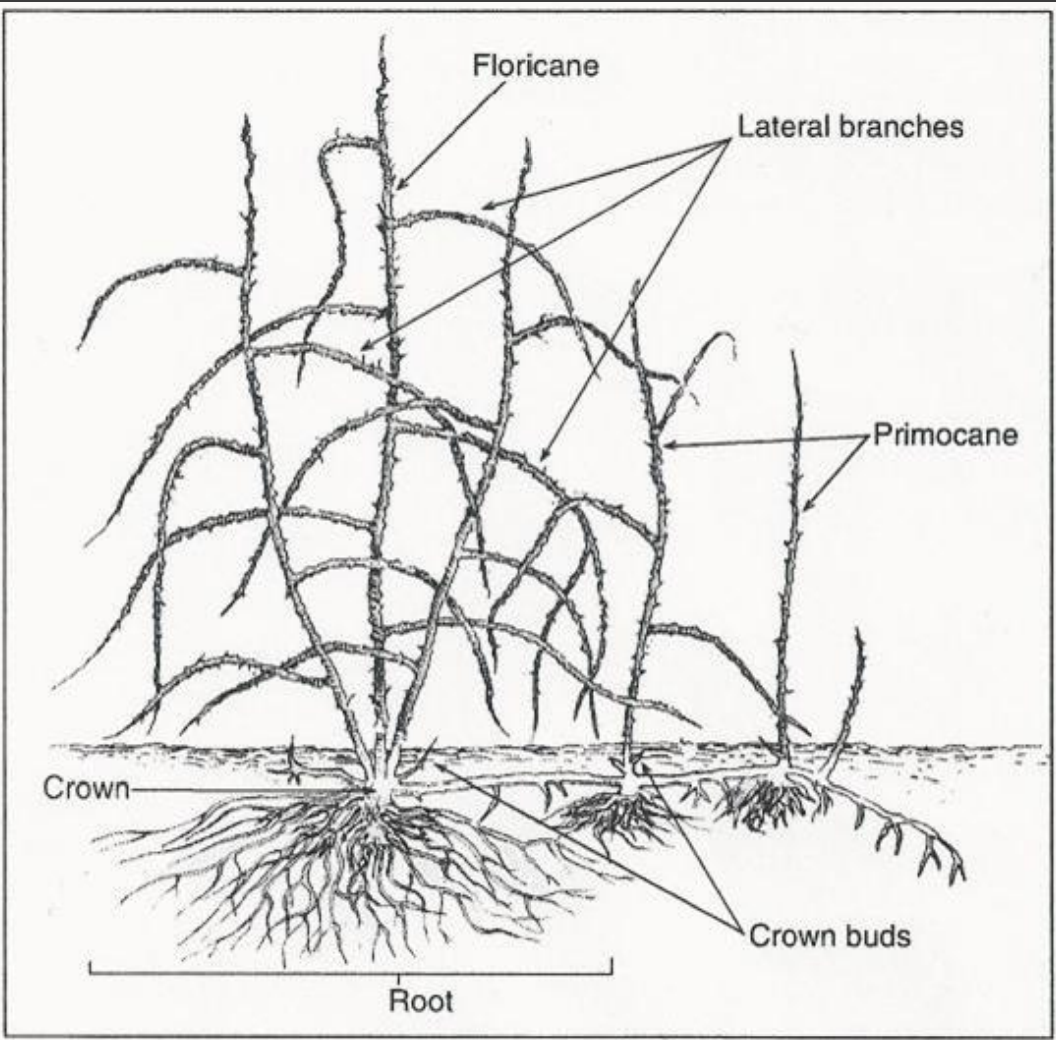
Brambles have two distinct types of canes: primocanes and floricanes (Figure 1). The difference between primocanes and floricanes is their age or maturity. Primocanes are one-year-old canes and floricanes are two-year-old canes. Other than age, primocanes and floricanes will behave differently, depending on whether they belong to the summer-bearing or fall-bearing group of brambles.
One of the main differences between this group of plants is when the fruit is ready to be harvested. There are both summer-bearing and fall-bearing brambles. Summer-bearing brambles are perhaps what most people think of when they think of a raspberry or blackberry with the fruit ripening in the summertime.
These brambles are also known as floricane-bearing brambles as their fruit is produced on their two-year-old floricanes. The canes in this group are biennial, taking two years to produce fruit. This group includes red, purple, and black raspberries as well as blackberries.
Alternatively, Fall-bearing, Everbearing, or Primocane-bearing brambles produce fruit on their one-year-old primocanes. Fall-bearing brambles provide annual fruit production. This group includes red, black, and yellow raspberries as well as some blackberries. Fall-bearing brambles can also be double-cropped. Double cropping will be discussed below.
The growth habits of this group of plants vary in multiple ways, including how and where new canes develop on the plant.
Red and yellow raspberries all spread via rhizomes underground. From these rhizomes, new root/shoot junctures develop allowing canes to develop away from the original crown of the plant. New canes will develop from both the crown of the plant and from the spreading rhizomes. This is how many brambles colonize or spread within a planting area.
However, black raspberries and blackberries do not spread via rhizomes. Instead, they have a compact crown, like that of a blueberry bush. All the new canes on black raspberries and blackberries will only develop from the originally planted crown.
Lastly, purple raspberries can exhibit both types of growth: having canes arise from the crown and from rhizomes.
There are pros and cons to each type of growth habit. For the purposes of pruning, it is only important to know which group you are working with at the time.
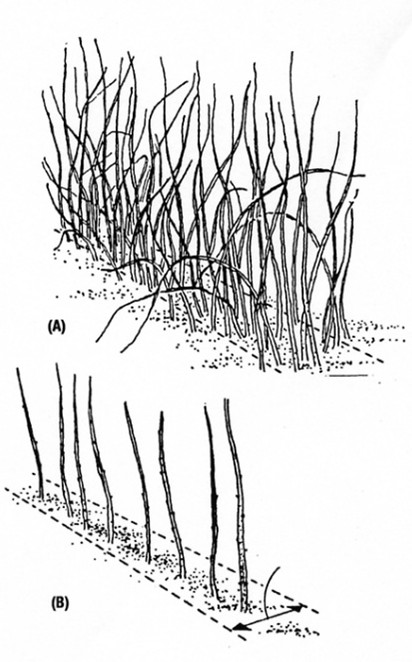
In addition to how and where canes develop on the plant, there are a few more differences in the growth habit of blackberries specifically. There are erect, semi-erect, and trailing blackberries. Erect blackberries can stand on their own and do not need a trellising system, like a blueberry bush. Semi-erect and trailing blackberries require the support of a trellis.
The cold hardiness of bramble canes varies a fair amount as well. Red raspberries are the most cold-hardy and can withstand temperatures down to -30 degrees F. All the other brambles are only cold-hardy down to about -10 degrees F.
Cold-hardiness affects the survivability of canes through to the next season, and therefore impact the pruning regimen. Additionally, even in cases of higher winter temperatures, cold winter winds can desiccate overwintering canes, resulting in the partial or complete death of a cane.
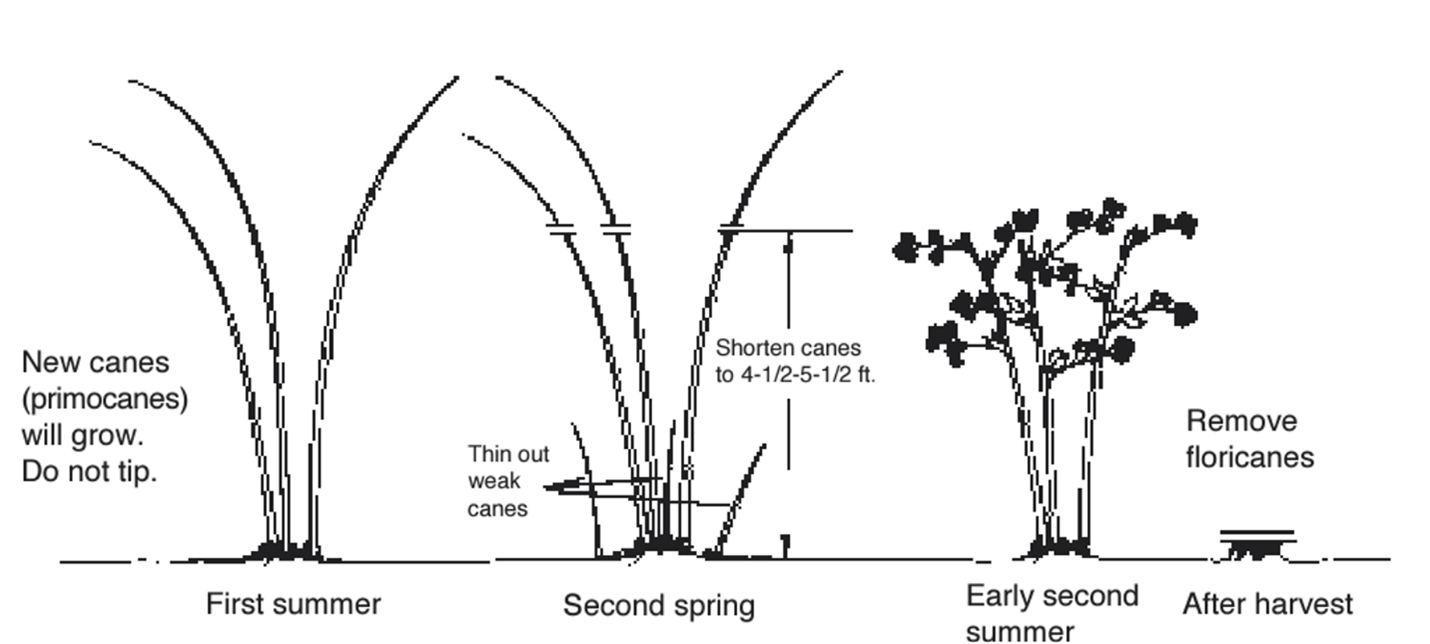
In the first year, plants will only have primocanes. These will not flower nor produce a crop. Primocanes will need to be maintained through the winter.
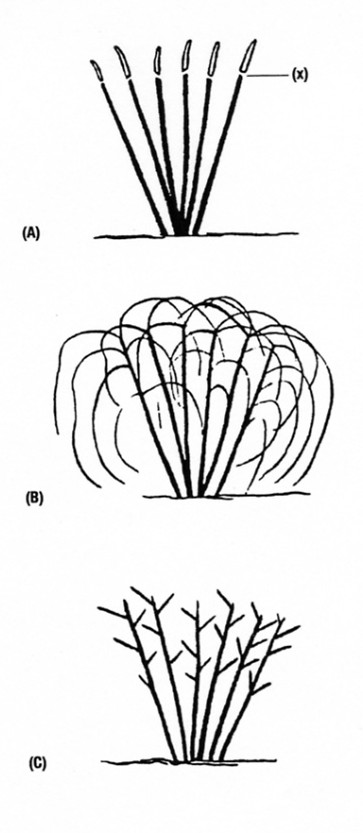
In year two, those primocanes become floricanes and will provide your first crop in the summer. Also in year two, floricanes may need to be tipped to encourage lateral branching. However, red varieties generally do not need to be tipped as they will branch on their own. Fruiting will occur on laterals.
After the floricanes have produced a crop, the floricanes will not produce another crop, and will need to be removed. All pruning should be done between end-of-season and early spring of the next year. See Figure 2 and the step-by-step guide below.
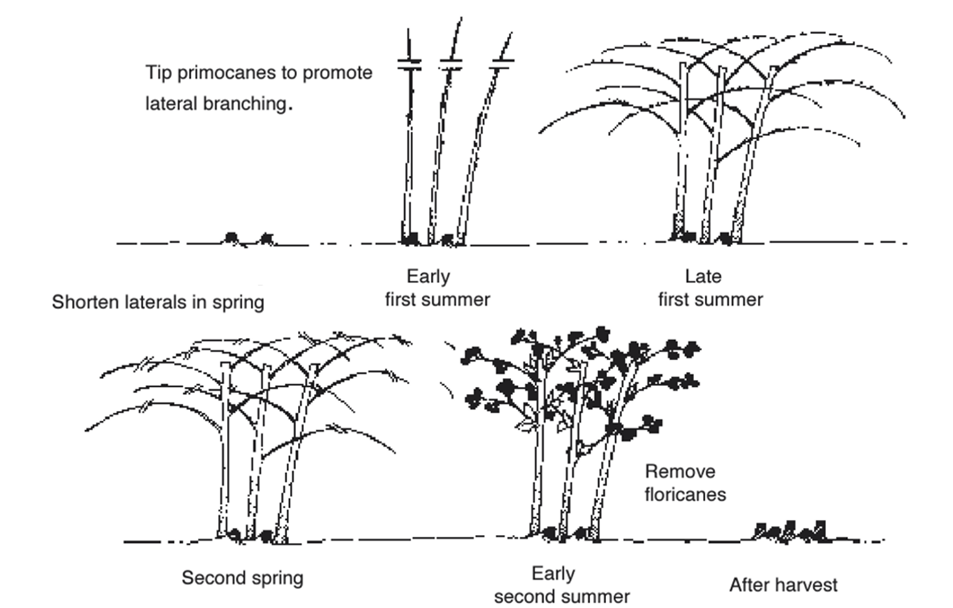
Most of what applies to summer-bearing red raspberries also applies to summer-bearing black and purple raspberries as well as blackberries. The only difference will be additional tipping of the primocanes in their first year. See Figure 4 and step-by-step guide below.
Fall-bearing brambles have the benefit of producing fruit on their primocanes, which provides an operation with annual fruit production. Therefore, maintaining and organizing both primocanes and floricanes each year is not required.
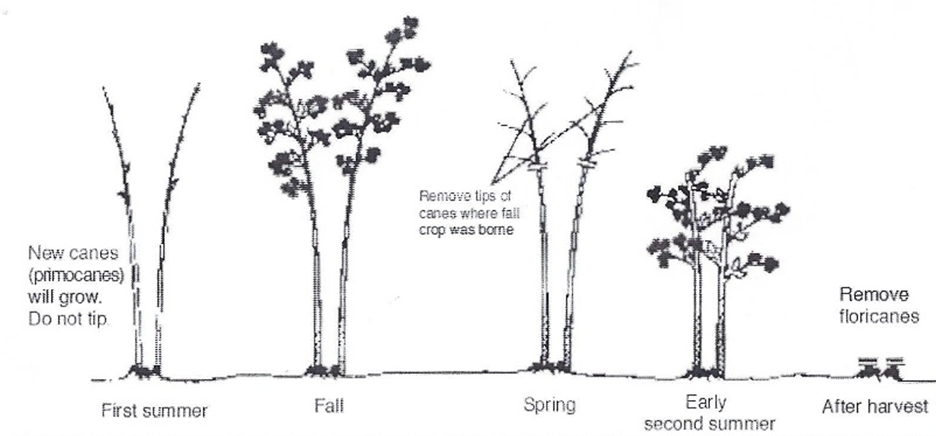
Each year, primocanes will produce a crop in the fall. These primocanes can then all be removed to make way for the next year’s primocanes to develop and fruit. However, fall-bearing brambles can also be double-cropped by tipping and maintaining floricanes into year two. The second crop provided by fall-bearing floricanes will be much smaller, and develop in the early summer of their second year. See the figure and step-by-step guide below.
The second crop will develop below this cut. This will help to reduce overwintering inoculum, and reduce the likelihood of infections on new berries, in the second crop.
Demchak, K. (2024, February 28). Pruning brambles in home fruit plantings. Penn State Extension. https://extension.psu.edu/pruning-brambles-in-home-fruit-plantings
Warmund, M. (2022, March). Pruning raspberries, blackberries and gooseberries (Publication No. G6000). University of Missouri Extension. https://extension.missouri.edu/publications/g6000
The information in this document is for educational purposes only. The recommendations contained are based on the best available knowledge at the time of publication. Any reference to commercial products, trade or brand names is for information only, and no endorsement or approval is intended. UConn Extension does not guarantee or warrant the standard of any product referenced or imply approval of the product to the exclusion of others which also may be available. The University of Connecticut, UConn Extension, College of Agriculture, Health and Natural Resources is an equal opportunity program provider and employer.