Spring Fungal Disease Outlook for Fruit Growers
Author: Evan Lentz
Evan.Lentz@uconn.edu
Reviewer: Mary Concklin and Shuresh Ghimire
Publication EXT110 | February 2026
Introduction
Spring comes fast every year, and with it numerous early-season diseases. Warming temperatures and frequent rains provide optimal conditions for many plant diseases to thrive. For most diseases, early control measures are essential and provide a degree of protection all season long. It is best to focus your attention on preventative disease control now, rather than playing catch-up later.
This fact sheet includes information on multiple common fruit diseases, along with some notes regarding how to best prevent troublesome early-season infections.
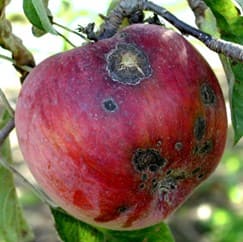
Apple Scab (Venturia inaequalis) remains one of the most important tree fruit diseases to manage in the Northeast region, affecting both the leaves and fruit of apple trees. Unmanaged primary infections will cause significant damage, compromising both fruit quality and overall yield.
The fungus, Venturia inaequalis, overwinters on debris in and around orchards. Primary infections occur in early Spring, starting around bud-break. Generally, scab spores mature around the same time that green tissues emerge, and continue to be released until one to two weeks post-petal fall.
Daytime rains serve to release mature scab spores and provide the wetting period necessary for infection to occur. Symptoms usually take nine to 17 days to present, depending on temperature. Primary infection sites produce additional spores (conidia) which kickstart the secondary disease cycle, and begin a series of potential secondary infections throughout the summer. This makes control of primary infections critical.
Corrective action decisions for apple scab should be based on the forecasting models available. The NEWA website (Apple Scab Forecasting Model) provides insight into potential infection events.
Fungicide applications should be timed around these designated infection events. Specific materials and rates will vary, based on mode of action and phenology. For fruit growers in the Northeast region, a typical apple scab fungicide program would include (adapted from the New England Tree Fruit Management Guide):
- A dormant to green-tip application of a copper fungicide, which has primary activity against Fireblight;
- From silver-tip through tight-cluster, a combination of a Captan (FRAC M4) and a Mancozeb (FRAC M3) or other EBDC fungicide is effective in most blocks. For high disease pressure situations, additional materials such as Syllit (FRAC U12), Vangard (FRAC 9), or Scala (FRAC 9) are recommended, but are limited to two applications per year;
- From tight-cluster through pink, the same Captan/EBDC combination works well in low-pressure situations. Since this is the height of primary scab season, even moderate risk situations warrant the use of a multi-site fungicide (either Captan or EBDC) and a single-site fungicide such as Flint (FRAC 11), Sovran (FRAC 11), Fontelis (FRAC 7), Aprovia (FRAC 7), Luna Sensation (FRAC 7+11), Merivon (FRAC7+11), or Luna Tranquility (FRAC 7+9);
- From petal-fall through first cover, the same Captan/EBDC combination works well in low-pressure situations. Again, higher-risk situations will require the use of a multi-site fungicide (either Captan or EBDC) and a single-site fungicide such as those listed above with the addition of Inspire Super (FRAC 3+9), Indar (FRAC 3), Topguard (FRAC 3), or Rally (FRAC 3);
Remember to always rotate materials. Be sure to check labels for important information, including annual usage maximums.
Orchard sanitation and selection of resistant plant material provide additional options for apple scab management.
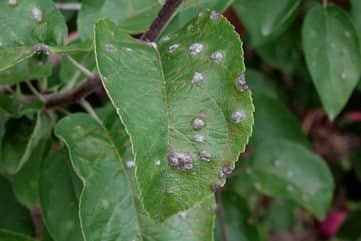
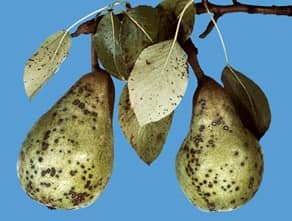
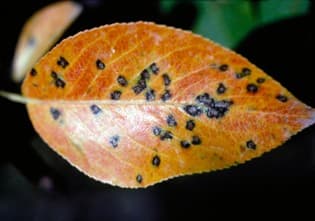
Fabraea Leaf Spot (Diplocarpon mespili) is a fungal disease affecting both pears and quince. Infections lead to leaf spotting, defoliation, and overall unmarketable fruit. This disease is fairly similar to that of apple scab. Fabraea overwinters on orchard debris, and the spores are released from mid-May to July, during rain events.
Primary infection sites will begin to present with symptoms about one week after initial infection. Secondary infections follow, and spread readily via wind and rain during the summer months. Wet weather during the summer exacerbates secondary infections.
Early season control is essential to curb the impact of secondary infections. EBDC fungicides and Ziram provide the best control. If applying materials to pears for apple scab, those materials will likely provide control activity for Fabraea as well, if an EBDC or Ziram is included in the mix. Koverall (FRAC M3) is also rated as having high efficacy.
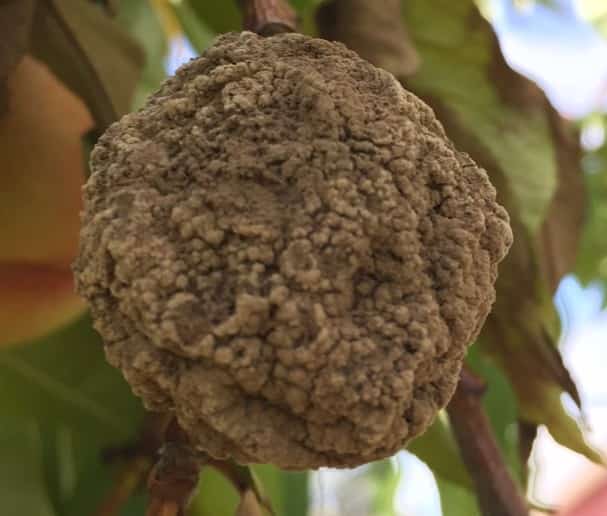
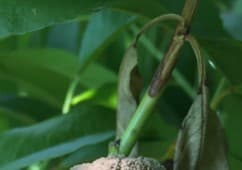
Brown Rot (Monolinia fruticola) is a fungal pathogen affecting all stone fruit, including peach, nectarine, plum and cherry. The pathogen overwinters on mummies in trees, fallen fruit, and in cankers found on twigs and branches. Fungal infection relies on warm temperatures along with a wetting period, and may present as blossom blight, shoot blight, and/or fruit rot.
Infections that occur early in the season might not show up until much closer to harvest time. Post-harvest infections are also likely.
Management of this pathogen relies on judicious removal of mummies and twigs affected with cankers. Chemical control should be focused first at bloom time through three weeks post-bloom. Materials such as Bravo (FRAC M5), Rally (FRAC 3), Indar (FRAC 3), Orius 20 AQ (FRAC 3), Rovral (FRAC 2), Fontelis (FRAC 7), Elevate (FRAC 17), Luna Sensation (FRAC 7+11), Merivon (FRAC 7+11), Topsin M (FRAC 1), and Captan (FRAC M4) are all rated as having excellent efficacy. Organic options include: Regalia (FRAC P5), Badge X2 (FRAC M1), BotryStop (FRAC NA), and Sterifel Biofungicide (FRAC 44). At three weeks prior to harvest, maintain coverage again if wetting periods occur.
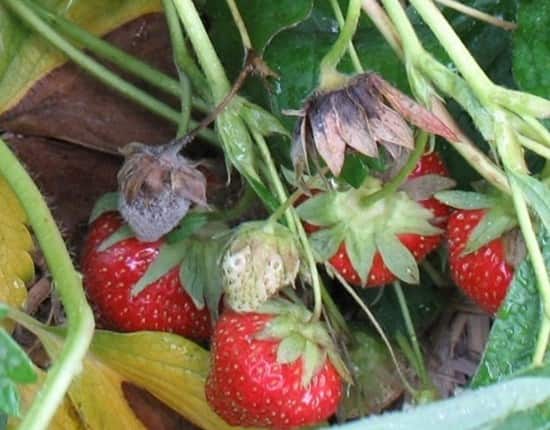
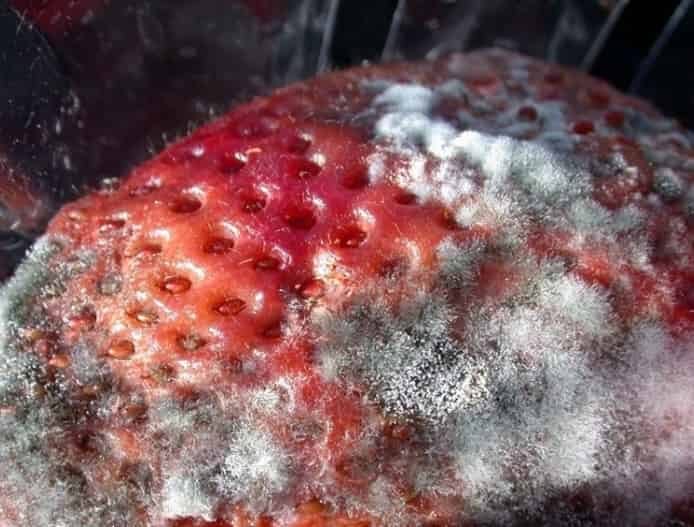
Botrytis Blossom Blight/Gray Mold (Botrytis cinerea) also known as gray mold, is a prolific fungal disease of strawberries and other fruit crops. This pathogen overwinters in soil debris. Spring wind and rain release its spores are released and spread. Young tissues, including developing leaves and blossoms, are highly susceptible to infection. During this time, the biggest concern is infection of the king blossoms. King blossoms give the biggest fruit; without them, crops can be severely impacted.
Protection against this disease begins with proper spacing during establishment, and diligent renovation practices. Promotion of good air circulation is key, this works to reduce extended wetting periods on various plant surfaces and prevents Botrytis spores from germinating.
For chemical control, fungicides should be applied during bloom, especially in locations with a history of this disease. Materials such as CaptEvate (FRAC 17+M4), Elevate (FRAC 17), Fontelis (FRAC 7), Inspire Super (FRAC 3+9), Kenja (FRAC 7), Luna Sensation (FRAC 7+11), Luna Tranquility (FRAC 7+9), Pristine (FRAC 7+11), Roval (FRAC 2), Scala (FRAC 9), Switch (FRAC9+12), and Topsin-M (FRAC1) are all rated as having excellent efficacy against Botrytis.
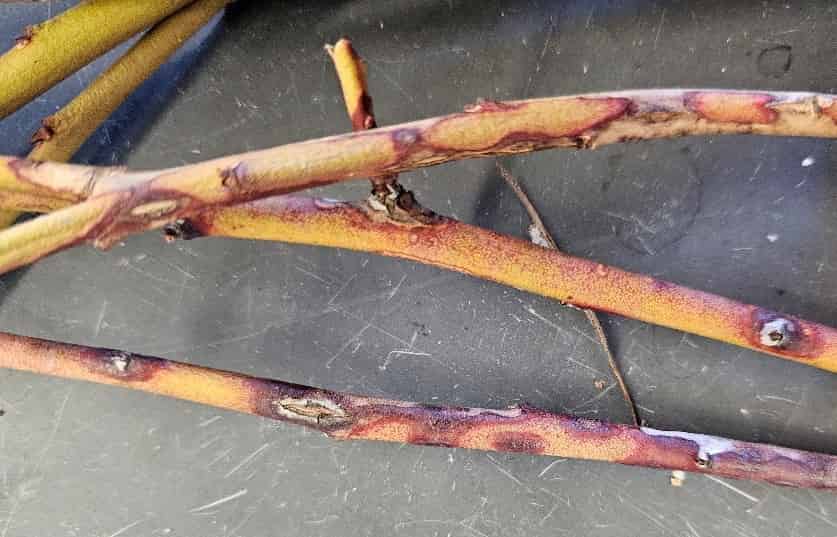
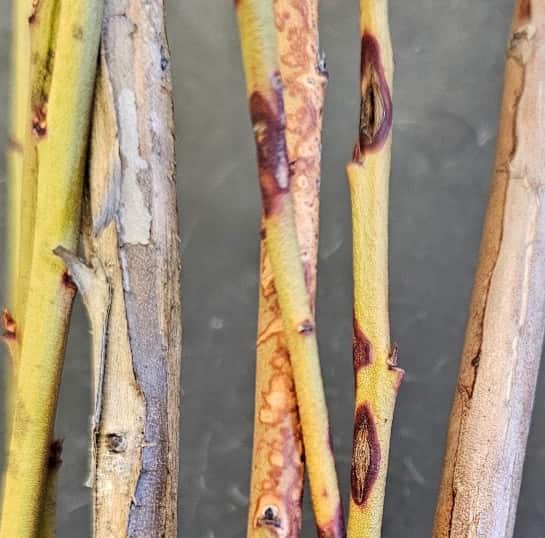
Phomopsis Twig Blight (Phomopsis vaccinii) is one of the most common blueberry stem cankers and is often mistaken for Fusicoccum. Phomopsis overwinters in old stem cankers from the previous year. Spores a re released during rain events in the spring. Mild winters add to the severity of this disease.
This disease can be particularly challenging as the pathogen can move from infected shoots, travel down to the crown of the plant, and then move up new uninfected shoots. Mechanical injury and severe weather contribute significantly to the severity of this disease.
Most blueberry cultivars are susceptible to this disease. Cultural management strategies such as judicious pruning, minimizing water stress, and adequate nutrient management can all provide protection against this pathogen. Beyond those, chemical management can begin as early as pre-bud-break with applications of lime-sulfur and copper products as part of dormant or delayed dormant sprays. Fungicide applications can begin in early bloom. Materials such as Indar (FRAC 3), Luna Sensation, (FRAC 7+11), Tilt/Orbit (FRAC 3), Pristine (FRAC 7+11), and Quash (FRAC3) are all rated as having excellent efficacy against this disease.
Resources
Apple Scab. MSU Extension. Integrated Pest Management. https://www.canr.msu.edu/ipm/diseases/apple_scab#gallery
Fabraea Leaf Spot. MSU Extension. Integrated Pest Management. https://www.canr.msu.edu/ipm/diseases/fabraea_leaf_spot#gallery
Network for Environment and Weather Applications (NEWA). https://newa.cornell.edu/
New England Tree Fruit Management Guide. https://netreefruit.org/
New England Small Fruit Management Guide. https://ag.umass.edu/fruit/publications/new-england-small-fruit-management-guide
Schilder, A. 2007. Be on the Lookout for Phomopsis Twig Blight in Blueberries. MSU Extension. https://www.canr.msu.edu/news/be_on_the_look_out_for_phomopsis_twig_blight_in_blueberries
The information in this document is for educational purposes only. The recommendations contained are based on the best available knowledge at the time of publication. Any reference to commercial products, trade or brand names is for information only, and no endorsement or approval is intended. UConn Extension does not guarantee or warrant the standard of any product referenced or imply approval of the product to the exclusion of others which also may be available. The University of Connecticut, UConn Extension, College of Agriculture, Health and Natural Resources is an equal opportunity program provider and employer.