Identifying Features
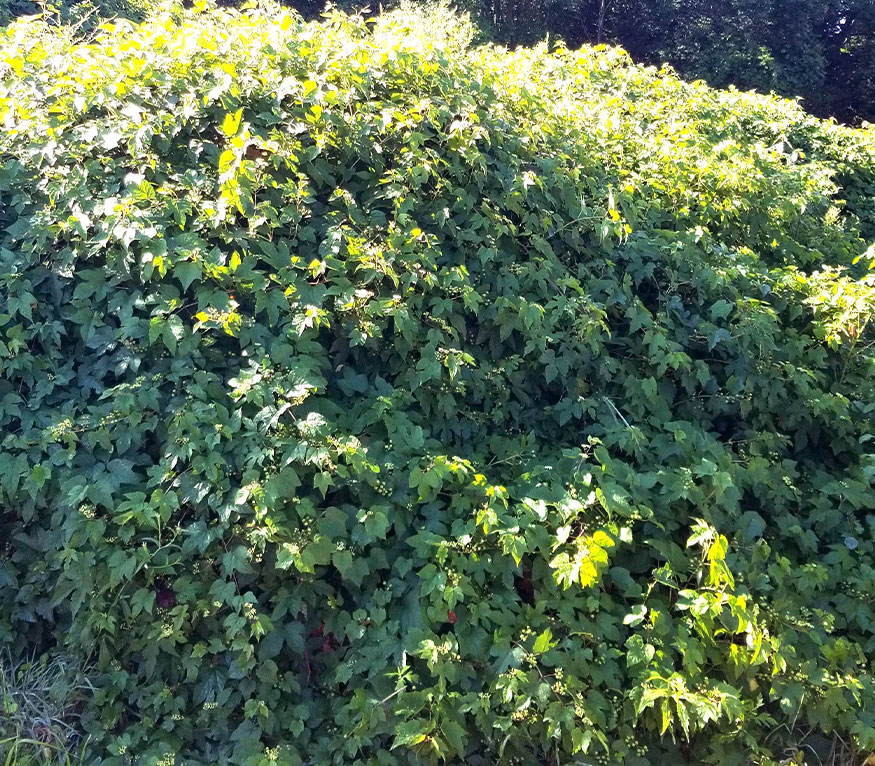
Porcelain-berry grows rapidly, and climbs, suffocates, and strangles other plants. In a single season, vines can grow up to 20 feet in length, creating a dense, sprawling, tangled monoculture (Figure 1).
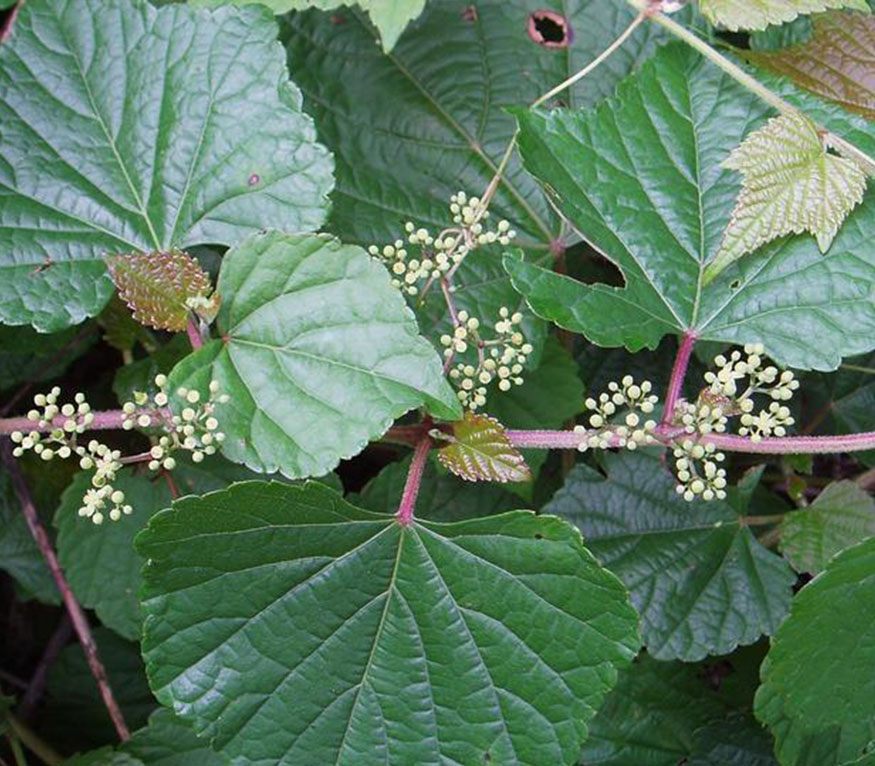
Alternate, broadly ovate leaves have a heart-shaped base (Figure 2). They are dark green to blue-green, and shiny on the upper leaf, with fine hairs on underside.
Leaves vary, with three to five lobes typical. The leaves have coarse teeth and distinctive thin whitish hair tips along the margins, and turn vibrant yellow in the fall.
The stems are branched tendrils that arise opposite leaf base on new growth, enabling the vine to climb. Unlike other native woody vines species in the Vitaceae family, these tendrils lack adhesive disks, which help distinguish the species.
New stems are whitish-green, smooth to lightly hairy, slightly square with regularly spaced swollen nodes. Bark is glossy, light gray to gray, and rough, with prominent lenticels, ridged and furrowed, splitting into diamond-shape patterns and forming thin flakes as the bark ages. The pith is white and continuous across the nodes. Stems can grow to four inches thick.
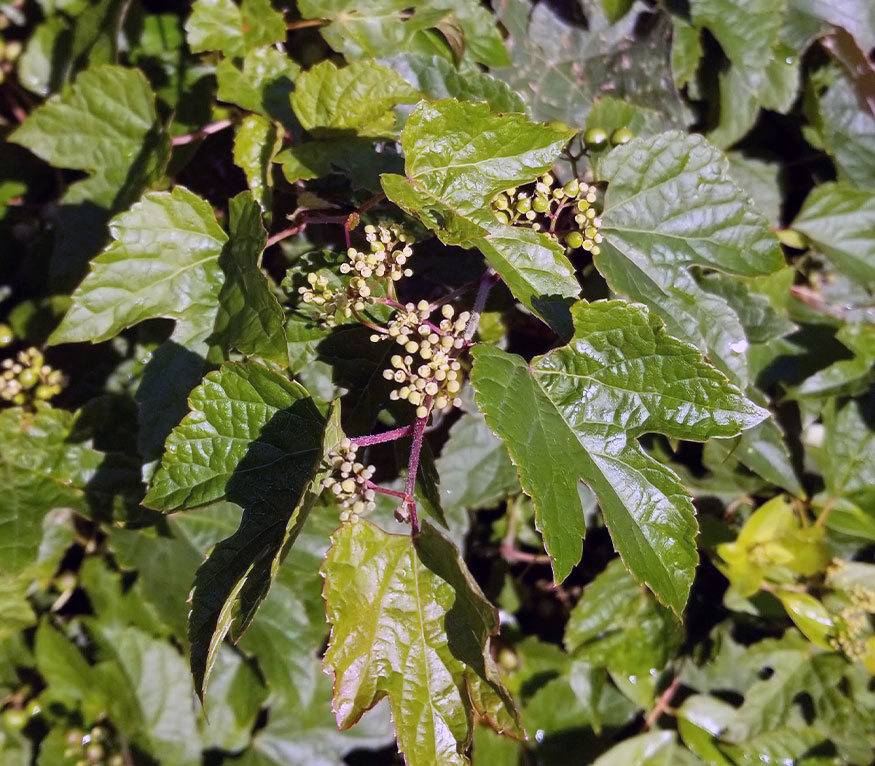
Flowers are inconspicuous, small and greenish-white (Figure 3), in branched clusters in late spring and summer. Flowering takes place on new growth.
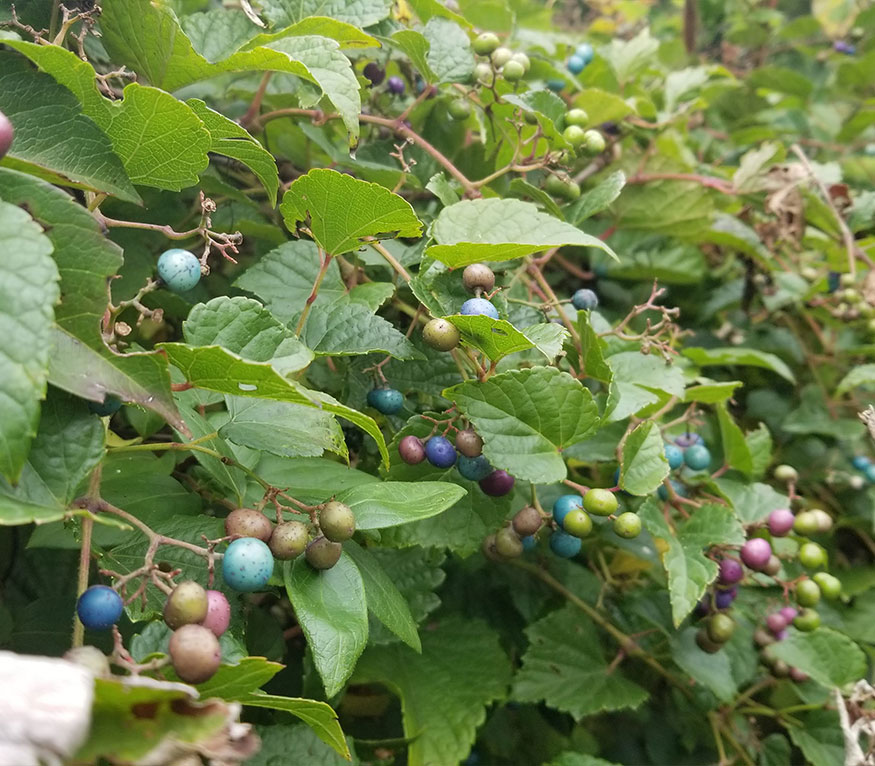
Berries appear in erect clusters in July-October, progressing from pale lilac, to green, to bright, metallic blue (Figure 4). Each berry contains two to four seeds and persists through winter.
Porcelain-berry produces primarily by seed, but can also reproduce by vegetative regeneration. Fruit and seeds are eaten and dispersed by birds and mammals. Seeds remain viable in the soil for years.
The porcelain-berry is often confused with the native wild grape (Vitis spp.), which has unbranched tendrils and shredded bark that lacks lenticels. The wild grape stem pith is brown and not continuous across nodes; its flowers have petals that touch at tips and occur in panicles. Porcelain-berry may also be confused with several native species in the same genus: Ampelopsis arborea and Ampelopsis cordata.
Habitat
Porcelain-berry can grow in a variety of habitats and soil conditions. It prefers rich moist soils and full sun but tolerates partial shade. It establishes at streambanks, forest edges, roadsides and other disturbed areas. The thick mats of vines formed by this plant can completely cover and shade out shrubs and young trees under its leafy canopy.
Control
Mechanical Control
For small infestations, seedlings/very young plants can be pulled or removed, preferably before flower buds form. Ensure the entire rootstock is removed. Seedlings are easiest to remove when the soil is moist. Pull steadily and slowly to minimize soil disturbance. Tamp down the soil after plants are removed to minimize seed germination. Larger vines may be cut back near the ground to kill top growth, although plants will regrow from the rootstock.
Routine monitoring for seedling emergence is critical. Seeds germinate readily and can remain viable in the soil for years. Porcelain-berry also resprouts from roots and fragments left in the soil; thorough removal and follow-up are essential. Where thick mats cover existing vegetation, lifting and cutting vines can help surviving native plants regenerate by exposing them to sunlight.
Plant material with fruit present should be burned or bagged and disposed of in municipal waste. Plant parts without fruit should be placed in the sun to dry out completely (solarization) to render plant material non-viable and may be put in a compost or mulch pile, provided care is taken to ensure that all removed plant parts are dead and no fruit is present as it can easily re-root from pieces of stem that are in contact with the soil.
Chemical Control
Follow label recommendations when handling and applying all chemical products. A licensed professional applicator may be consulted or hired to apply herbicides.
In areas with large infestations, chemical treatments may be necessary. Systemic herbicides such as glyphosate or triclopyr can be applied to foliage or to the cut stems of larger vines from early summer through fall. Cut stem herbicide applications should be avoided if stems are growing along or carpeting the ground. Porcelain-berry can easily re-root from pieces of stem that are in contact with the soil.
For basal bark applications, a higher concentration of triclopyr mixed with basal oil may be applied to easily accessible sections of vines. Follow-up examination of treated vines is essential, as re-sprouting and emergence of new seedlings is common due to the persistent seed bank in the soil.
Distribution
Porcelain-berry is found from New England to North Carolina and west to Michigan. It is most widespread in the Northeast U.S (Figure 5).
Background and Native Alternatives
Native to Japan and parts of northern China, porcelain-berry was first brought to the U.S. around 1870 for the perceived ornamental and horticultural value at the time.
Some native plant substitutes to consider after porcelain-berry plants are removed include trumpet honeysuckle (Lonicera sempervirens), Virginia creeper (Parthenocissus quinquefolia), and goldflame honeysuckle (Lonicera heckrottii).