Description and Life Cycle
The Spotted Wing Drosophila is an invasive species of vinegar gnat that was introduced to the continental United States in 2008 and became a major pest in Connecticut by late summer in 2011. SWD is native to southeastern Asia where it thrives in hot and humid climates. It has a unique ability to affect a wide variety of hosts (most preferably raspberries, blackberries, and blueberries) yet it has also been seen to affect cherries, grapes, plums and strawberries.
SWD can have nine to 12 generations in one growing season. This reproductive frequency makes SWD difficult for diversified farms to manage, as winged adults can migrate between fruit crops throughout the season. Early detection in early June followed by effective control measures of SWD is essential to mitigating crop damage and the establishment of future generations.
Adults of the last generation of the previous year overwinter in brush and unmanaged weeds within fruit blocks or edges. Females typically emerge a few days before males are detected. The adults emerge between early and mid-June in many June bearing strawberry fields. SWD can establish a population early in the season because of its ability to lay eggs in developing fruit as well as ripe fruit. Larvae have three development stages and one final pupa stage taking anywhere from 1 to 3 weeks to complete depending on temperature and humidity.
SWD adults are most active when temperatures are between 55 F and 85 F, lower or higher temperatures cause a drastic decrease in adult activity. In Connecticut, SWD activity and capture becomes more frequent throughout late June and peaks around mid to late July. This is correlated with the end of June-bearing strawberry season and the beginning of raspberry and blueberry season. Females, over the course of their 30-to-60-day lifespan, can lay hundreds of eggs. Numbers gradually drop over the course of August and September. In systems with chemical control, one or two generations may occur in October until adults seek shelter to overwinter. Over wintering populations have been found to have a high mortality rate in the Northeastern United States. However, SWD numbers can rise to previous year’s populations over the course of a growing season due to early and quick population growth.
Identification
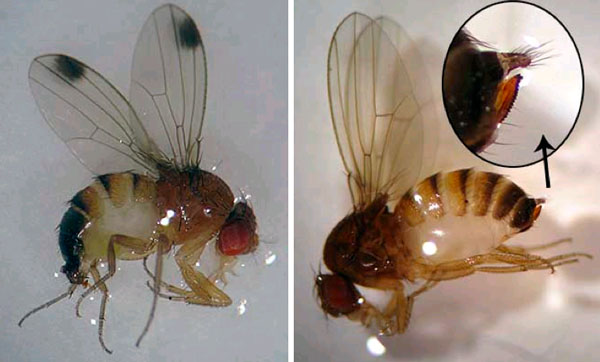
The Spotted Wing Drosophila resembles other vinegar gnats in overall size and has tan coloring with red eyes. Black bands are observed going horizontally across the abdomen and the cross veins of the wings are distinctive. Females are difficult to differentiate from other drosophila species but can be identified by their serrated ovipositor. Males can be identified by the characteristic black spot on the tip of the wings (Figure 1).
Damage
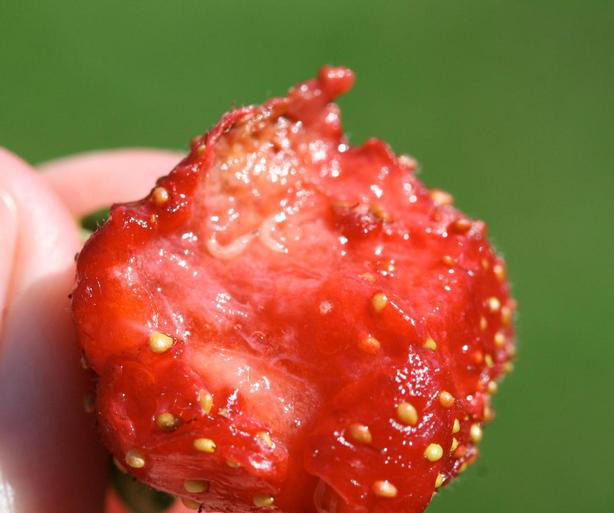
The serrated ovipositor of the female SWD is used to insert eggs directly into the flesh of fruit. In contrast to other species of fruit fly which lay eggs in ripe or overripened fruit, the serrated ovipositor allows SWD females to lay eggs in fruit that is not yet fully ripe and still marketable. Internal larval feeding of infected fruits reduces marketable yield and can cause secondary rot infections of picked fruit (Figure 2). Infected fruit can be identified by wrinkled skin, wet spots, and overall loss of turgidity. Early-stage larvae or eggs may leave no visible symptoms, but infected fruit will deteriorate quickly.
Monitoring
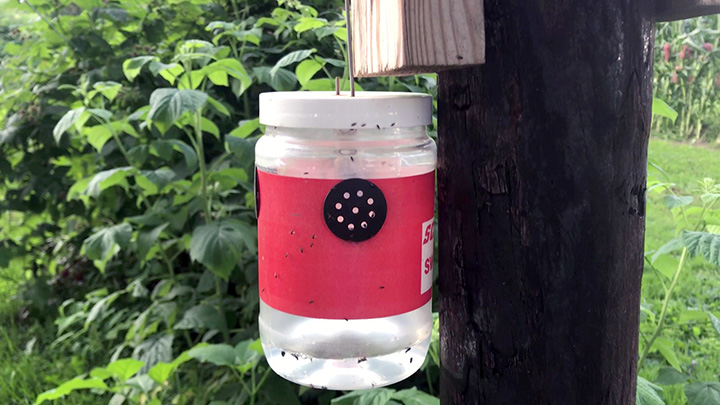
Monitoring is essential for effective SWD management. Sticky traps and other baited traps should be used to monitor populations in all small fruit cropping systems and be used to inform pesticide application decisions (Figure 3). Alternatively, homemade monitoring traps utilizing covered cups and a fruit juice solution or apple cider vinegar are also effective. Traps should be set out at least two weeks before fruit begins to ripen and placed in a cool, shady area within the crop canopy. The current threshold for SWD is one adult SWD per trap when fruit is ripe. Traps should be checked, cleaned, and refilled once per week. Identification of specimens caught in traps can be done by using a dissecting microscope or at the very least a magnifying hand lens.
Management
Cultural
Weed management within and around the growing areas is one of the most effective ways of controlling SWD populations. This includes removing wild hosts (elderberry, pokeweed, honeysuckle, buckthorn) from field edges. Likewise, consistent pruning reduces canopy density and modifies the SWD’s preferred environment by introducing light and airflow. This also ensures adequate spray penetration if chemical controls are used. Reduce or eliminate overhead watering to keep the canopy dry. Operations that do not rely on PYO should keep up on their picking. By avoiding overripe fruit, production areas are not as attractive to SWD.
Mechanical
Exclusion netting creates a physical barrier between SWD and ripening fruit, it can be very effective if installed before the arrival of SWD. Netting with an 80-gram net can be effective if kept free from holes. Netting also provides protection from other insect pests and birds.
Chemical
Chemical control is only effective against adult populations. Eggs and larvae are protected from pesticides inside infested fruit. It is always best to inform spray decisions with monitoring efforts. Rotate pesticides from various IRAC groups or those with different modes of action to avoid the development of resistance. Use frequent, thorough applications of pesticides with short pre harvest intervals. Broad‑spectrum materials including organophosphates, pyrethroids, and spinosyns will provide short term control. Organic materials have been shown to have poor efficacy. Consult the New England Small Fruit Management Guide for specific recommendations, including materials and rates.
Biological
No biological control agent is currently available. Researchers are exploring the use of biological control agents to suppress Spotted Wing Drosophila populations.