Beech Wooly Aphids and Sooty Mold
Author: Pamm Cooper
Pamela.cooper@uconn.edu
Reviewer: Lauren Kurtz, UConn Extension
Publication EXT201 | March 2026
Introduction
During the fall wooly aphid activity may be found on beech and other hardwoods. Particularly on American beech in the Northeast, the native beech blight wooly aphid, Grylloprociphilus imbricator, may be found by the hundreds actively feeding on branches and twigs well into November.
Wooly Aphid Indicators
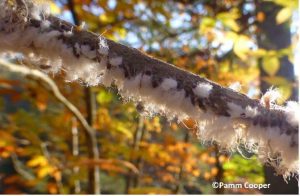
The wooly aphid can be seen easily as leaves fall, because their bodies are covered with white filament. These aphids feed on newer woody tissue and not on the beech leaves. This aphid is found only on American beech (Fagus grandifolia).

To Control or Not Control
These aphids are nicknamed boogie woogie aphids for their dance-like movement, especially when they are alarmed, or it is windy. While they form large colonies and seemingly cover smaller branches, tree health has not been determined to be negatively affected to a point where control measures are needed. On smaller trees with less biomass and more tender branches, appropriate control products may be used, if damage seems severe.
Aphids and Sooty Mold
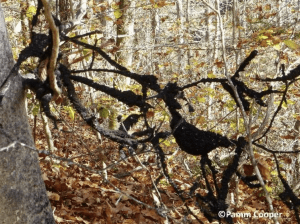
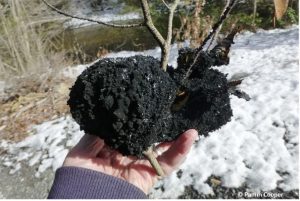
An indicator that these aphids are on a tree is the development of a singular sooty mold caused by the pathogen, Scorias spongiosa. This spongy black mold develops on honeydew excrement that drips down as it is excreted by the aphids feeding above. It can cover leaves with a thick, black fungal growth that can completely cover leaves and twigs, in some cases looking like a black version of Spanish moss. Sometimes large blobs of sooty mold, several inches long or thick, are found on the lower parts of infested trees. This mold is more an aesthetic issue than harmful to the tree, as leaves are ready to fall at that time of year.
Resources
Boggs, Joe (September 20, 2021) Beech Blight Aphids are Jitterbugging Across Ohio OSU.EDU Beech Blight Aphids are Jitterbugging Across Ohio | BYGL (osu.edu).
Childs, R. (2016, October 26). Beech Blight Aphid. Center for Agriculture, Food, and the Environment. https://ag.umass.edu/landscape/fact-sheets/beech-blight-aphid
The information in this document is for educational purposes only. The recommendations contained are based on the best available knowledge at the time of publication. Any reference to commercial products, trade or brand names is for information only, and no endorsement or approval is intended. UConn Extension does not guarantee or warrant the standard of any product referenced or imply approval of the product to the exclusion of others which also may be available. The University of Connecticut, UConn Extension, College of Agriculture, Health and Natural Resources is an equal opportunity program provider and employer.