Norway Maple (Acer platanoides)

Authors: Carla Caballero, Alyssa Siegel-Miles, and Victoria Wallace
victoria.wallace@uconn.edu

Reviewers:

Publication EXT208 | April 2026

DOI Pending

Introduction

The Norway maple (Acer platanoides) is a broad-canopied deciduous tree, and an invasive plant. It is common in urban landscapes, and along roadsides. It is increasingly found to be invading undisturbed forests and woodlands.

Norway maple is now widespread across the Northeast and Midwest, with established populations in the Pacific Northwest and California. It is native to continental Europe and western Asia, and was brought to the U.S. in the mid-1700s, and began to be widely planted as a street tree in the 1800s.

Horticultural interest in the species increased after Chestnut blight and Dutch elm disease reduced urban tree populations. More than 100 cultivars have been developed.

This fact sheet covers identification and management of Norway maple, which damages the environment by displacing native species, and reducing biodiversity.

The Sugar maple (Acer saccharum) and red maple (Acer rubrum) are recommended native alternatives.

Identifying Features

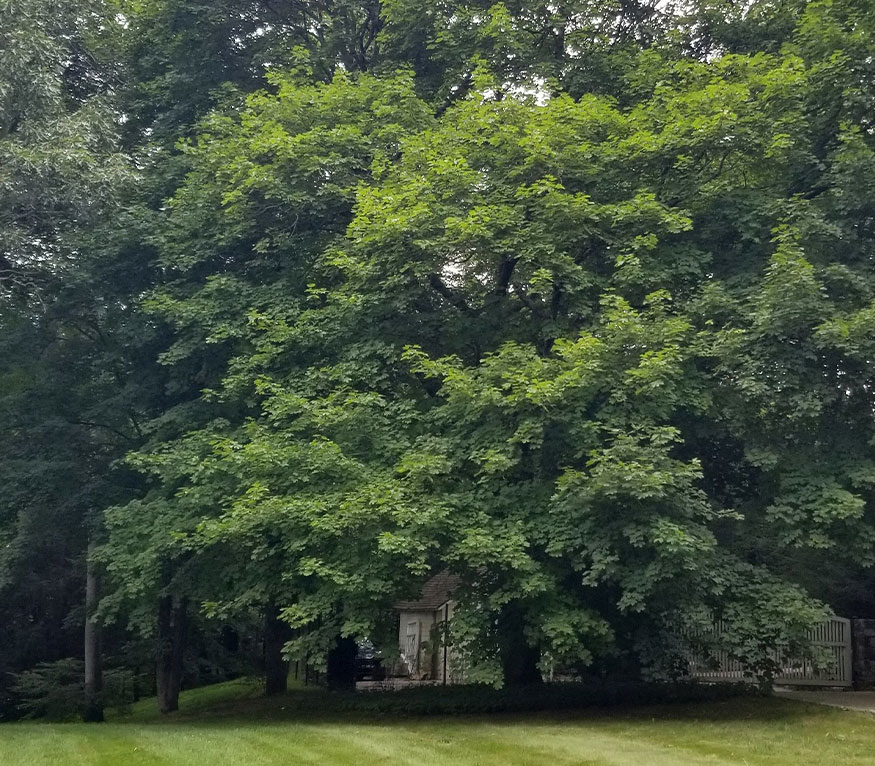
Mature trees typically reach 40-90 feet in height, and have a dense, rounded and symmetrical canopy, supported by upward spreading branches (Figure 1).
Norway Maple tree with green foliage.
Figure 1 Growth habit - mature plant

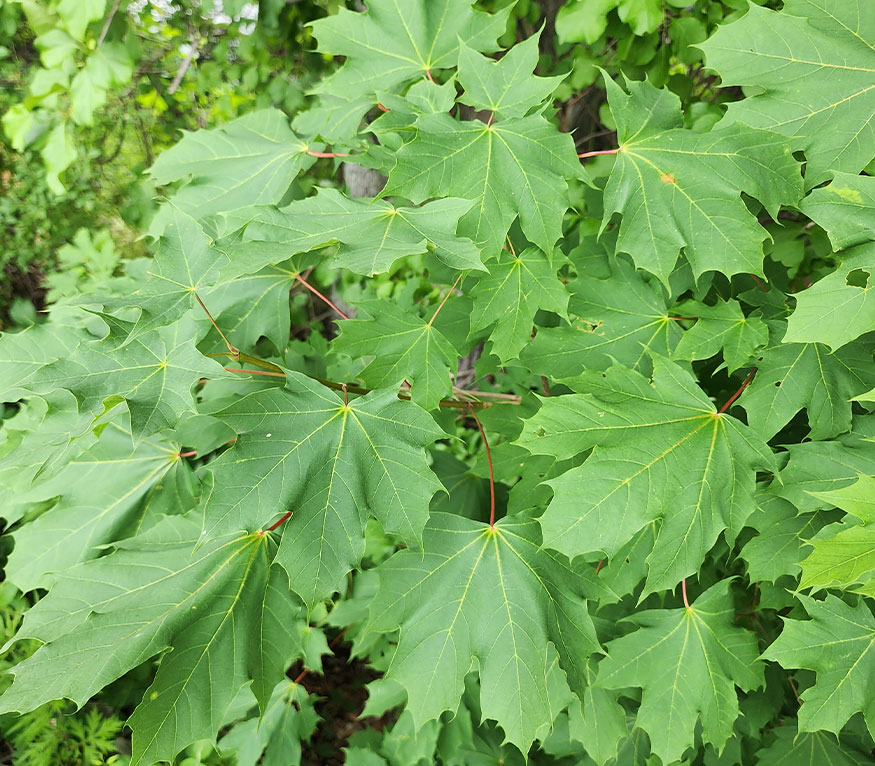
Leaves are opposite, dark green, and usually four to seven inches across, with five to seven lobes (Figure 2). Cultivars such as ‘Crimson King’ have deep red or purple foliage.
Norway Maple tree leaves closeup.
Figure 2. Foliage

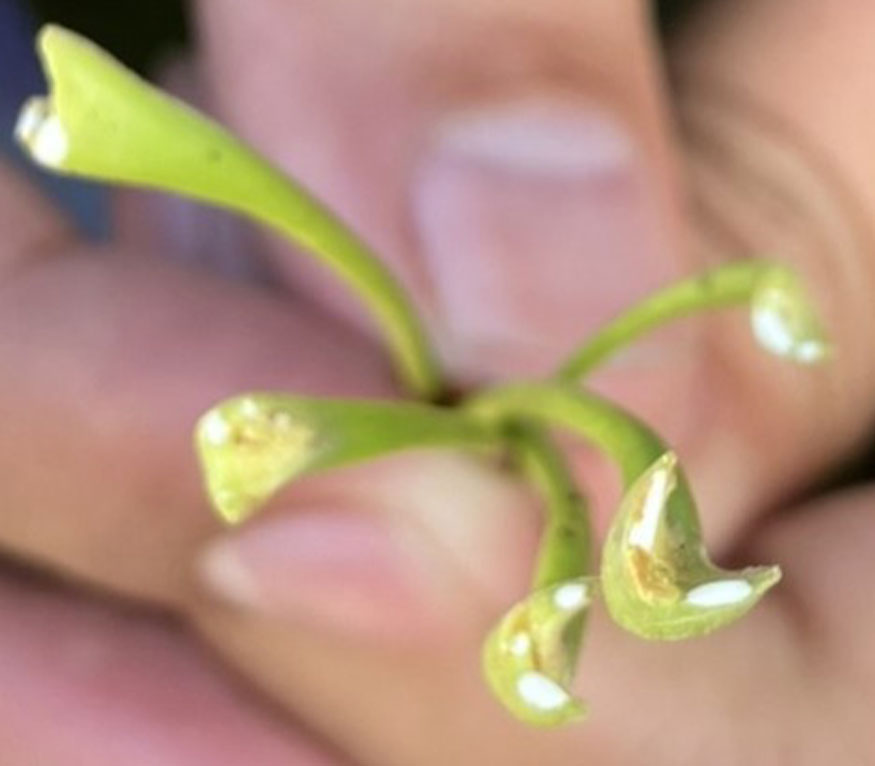
The leaf petioles exude a white sap when broken, which distinguishes it from native maples (Figure 3). Leaves turn yellow in fall and often persist longer than those of native maples.
Closeup of Norway Maple tree leaf stems cut showing the milky sap.
figure 3 Characteristic milky sap of Norway maple exuding from petiole after leaf cut

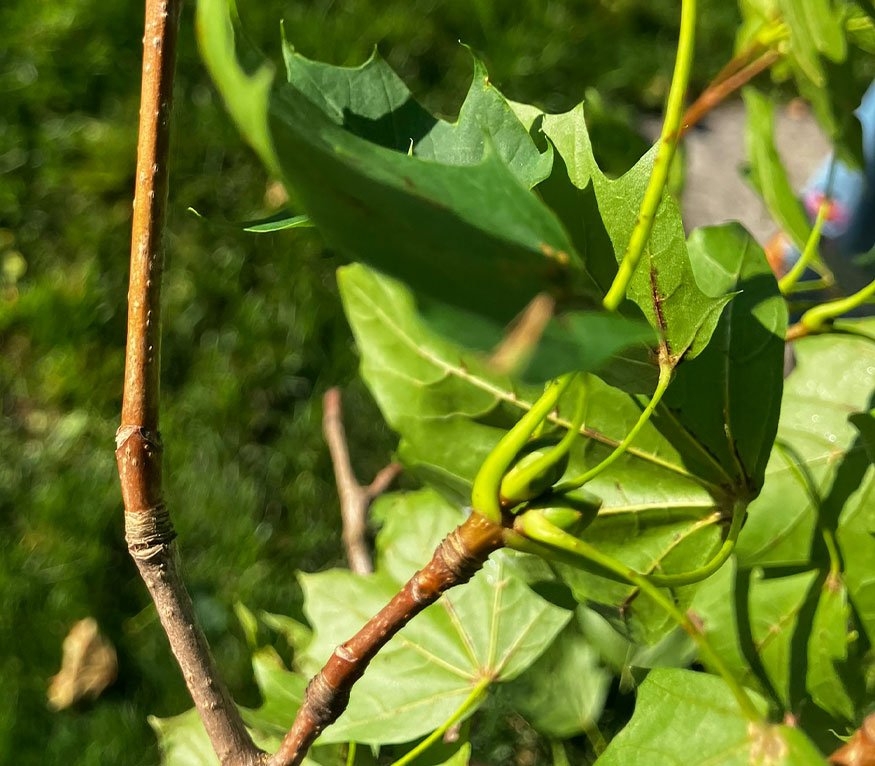
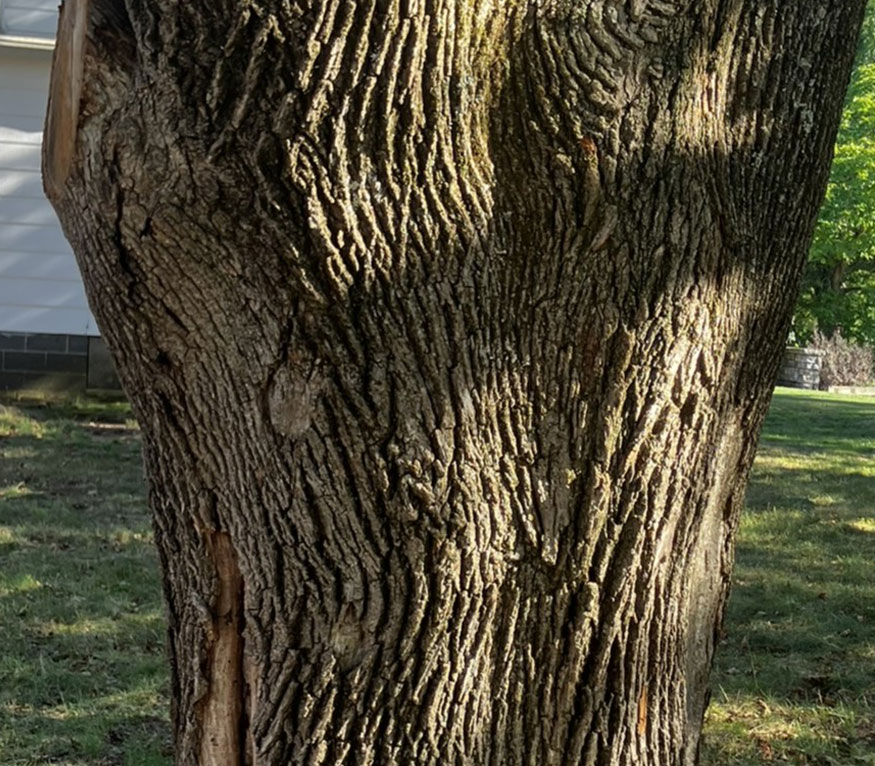
Twig stems are stout, brown, and glabrous (Figure 4), with rounded green buds protected by overlapping scales. Young bark is smooth and gray-brown, becoming darker and furrowed with age (Figure 5).
Brown young twigs showing with green leaves
Figure 4. Brown young twigs

Norway Maple tree closeup of bark.
Figure 5. Furrowed bark of a mature tree

Small, yellow-green flowers appear before leaves in Spring, from late April to early June, depending on the climate. Paired, winged seeds (samaras) develop early and mature by late summer (Figure 6). The winged seeds of Norway maple lie flat at 180°, while samaras of sugar maple and other native maples droop to form a horseshoe shape (45°-90°). Samaras are dispersed widely by wind and germinate readily, even in shaded conditions, enabling rapid colonization of forest edges and interiors.
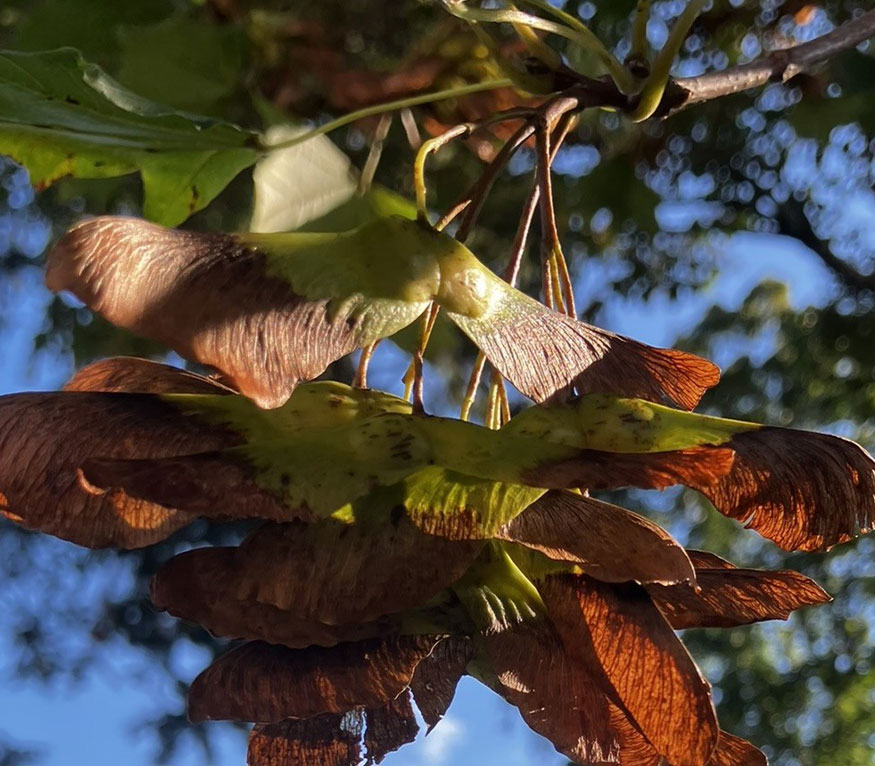
Norway Maple tree closeup of samaras.
Figure 6. Horizontal samaras at 180 degrees

Roots are shallow, vigorous, and wide-spreading, which compete aggressively with understory vegetation and turfgrass. Roots often damage sidewalks in urban sites.

Habitat

The Norway maple thrives in varied, diverse environments. It tolerates shade, drought, soil compaction, and pollution. It commonly invades and thrives in managed landscapes, transmission line right-of-ways, meadows, woodlands, and forest edges. It also has been found to penetratesmature established habitats, including forest interiors.

Effective management requires consistent follow-up and monitoring.

Mechanical Control

Hand-pulling/digging

Suitable for seedlings or small plants. Best done when the soil is moist. Be sure to remove the entire root system. Use tools such as weed wrenches to ease removal of medium-sized plants.

Cutting/girdling

To girdle a tree, make a complete cut around the trunk about six inches above ground level, removing both the bark and cambium layer. Girdling is most effective in Spring, when sap is rising, or in mid to late summer, when nutrients are moving downward to the roots. Cutting or girdling of larger trees can be effective, but resprouting often occurs and the action must be repeated.

Chemical Control

Follow product label directions when applying all chemical treatments. Trees taller than 15 ft. may require treatment by a certified arborist or licensed professional pesticide applicator, as specialized equipment and credentials are often required for safe and legal application.

Cut stump

In Fall or early Winter, cut stems near ground level, and apply systemic herbicide directly into fresh cuts or girdles within minutes after cutting. Resprouts must be cut and retreated. Effective herbicides include glyphosate and triclopyr. Treatments remain effective down to 50 °F.

Hack-and-squirt

This is a practical and efficient method when Norway maple is growing close to desirable trees. Use a hand axe to make downward-angled cuts around the tree stem to reach the cambium or growing layer. Apply systemic herbicide (glyphosate or triclopyr) immediately to the wounded stem after cutting. This treatment is most effective from middle to late Summer.

Foliar Spray

Apply glyphosate to the surfaces of leaves in late Summer through Fall. Since Norway maple retains foliage after many native plants have dropped theirs, this timing helps reduce harm to non-target species.

Use proper equipment to avoid misapplication of product onto applicator and neighboring plants. People apply chemicals should wear appropriate personal protective equipment (PPE).

Important

In all cases, monitor treated trees during the subsequent growing season to ensure successful control and repeat treatment as needed.


Resources

Abbey, T. M. (Ed.). (2004). Alternatives for invasive ornamental plant species (By The Connecticut Agricultural Experiment Station & Connecticut Invasive Plant Working Group). https://portal.ct.gov/caes/special-features/special-features/special-features.

Mehrhoff, L., Wray, P., & John Randall. (n.d.). Invasive plants in Pennsylvania. https://waterlandlife.org/invasives/norway-maple/.

Munger, Gregory T. (2003). Acer platanoides. In: Fire Effects Information System, [Online]. U.S. Department of Agriculture, Forest Service, Rocky Mountain Research Station, Fire Sciences Laboratory (Producer). https://www.fs.usda.gov/database/feis/plants/tree/acepla/all.html.

New Hampshire – Department of Agriculture, Market & Food. (n.d.). Norway maple (Acer platanoides) https://www.agriculture.nh.gov/publications-forms/plant-industry.htm.

Nowak, David J.; Rowntree, Rowan A. 1990. History and range of Norway maple. Journal of Arboriculture. 16(11): 291-296. https://research.fs.usda.gov/treesearch/18721.

Swearingen, J.M. and J.P. Fulton. (2022). Plant Invaders of Mid-Atlantic Natural Areas,

Field Guide. Passiflora Press. 200 pp. https://vnps.org/product/plant-invaders-of-mid-atlantic-natural-areas-field-guide

Utah State University – Forestry Extension. (n.d.). Norway maple (Acer platanoides) https://extension.usu.edu/forestry/tree-identification/maples/norway-maple.

The information in this document is for educational purposes only. The recommendations contained are based on the best available knowledge at the time of publication. Any reference to commercial products, trade or brand names is for information only, and no endorsement or approval is intended. UConn Extension does not guarantee or warrant the standard of any product referenced or imply approval of the product to the exclusion of others which also may be available. The University of Connecticut, UConn Extension, College of Agriculture, Health and Natural Resources is an equal opportunity program provider and employer.