Description and Life Cycle
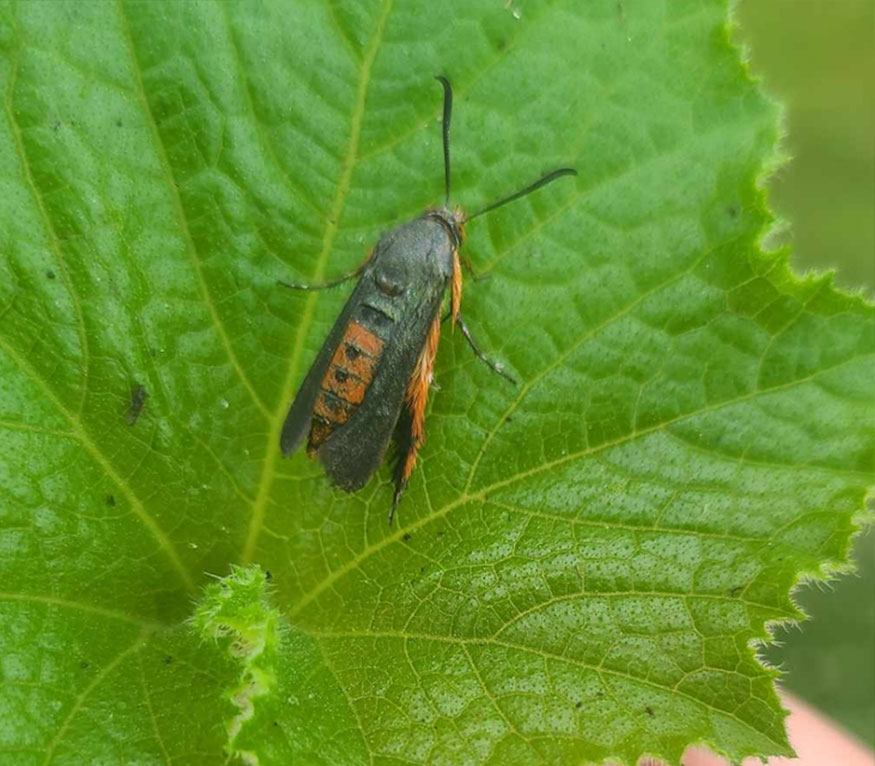
The adult SVB is a red-orange and black winged, day-flying moth that mimics a wasp (Figure 1). Adults emerge from early to mid-summer, laying their eggs at the base of squash plant stems. When the eggs hatch, tiny caterpillars emerge and bore their way into the plant stem. Larvae feed on squash plants from the inside out until they are ready to pupate.
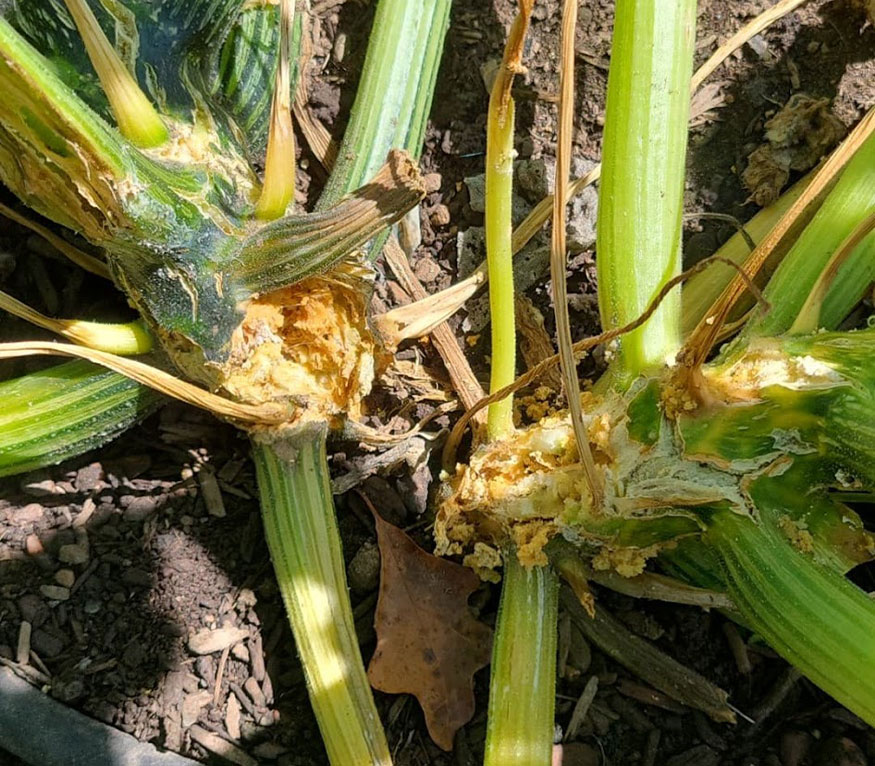
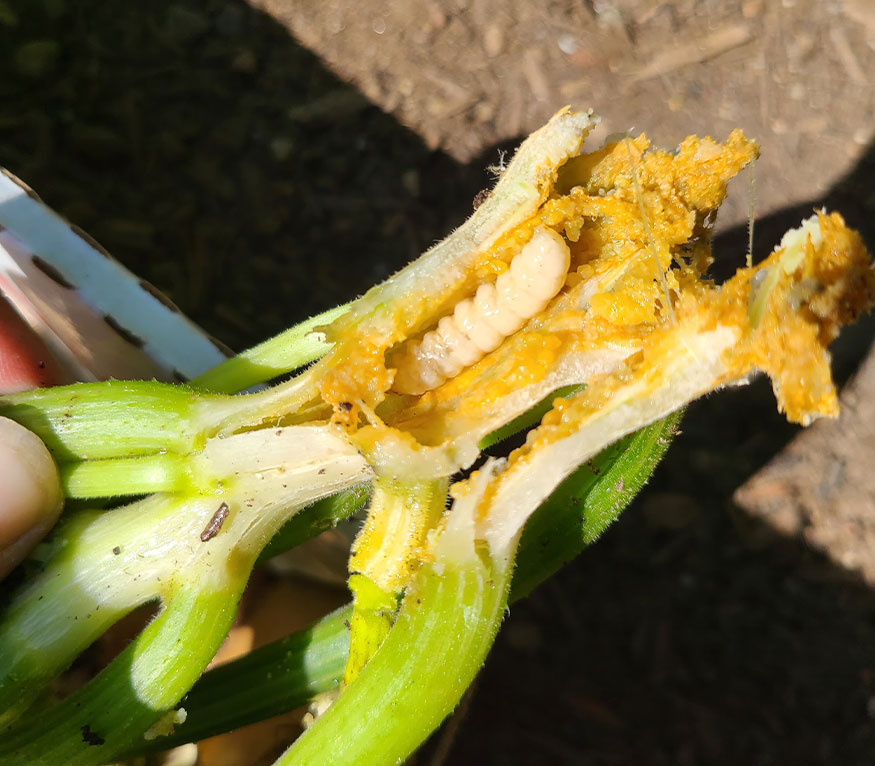
Feeding causes girdling of the stem from the inside. Gardeners may not even notice their presence until they see squash plants wilting in the summer heat. Upon inspection, a yellow, sawdust-like frass and entry hole at the base of the stem is often found (Figure 2). Once this is observed, larvae (Figure 3) are already in the stem and feeding.
Mature larvae exit the stem and burrow into the soil, where they pupate and overwinter. In the Northeast U.S., there is typically one generation per year, and adults will emerge the following growing season.
Management
Management strategies for the home gardener primarily focus on monitoring, plant selection, and physical exclusion, or removal of the insects. While biological and chemical controls are available, they require precise timing to be most effective.
Monitoring
- Start scouting for the adult moths in mid-late June
- Traps can be used to help monitor moth activity;
- Place a yellow pan, bowl, or pail filled with water and a drop of dish soap near your cucurbit plants to trap adult SVB moths. They will be attracted to the yellow container and drown in the water;
- Pheromone traps are also available and best placed just above the leaf canopy of the plants.
- Check stem bases for egg masses if adults are spotted;
- If wilting is present, check for frass and entry points along the base of the stem.
Cultural Control
Plant Selection
If you’ve had issues with SVB in the past, selecting resistant types of cucurbits for a few seasons may help to deter pest populations.
- Cucurbita pepo is highly susceptible to SVB. This species includes zucchini, summer squash, and pumpkins. They have thin walled, hollow stems, which make it easy for the larvae to bore into;
- Cucurbita maxima, which includes winter squash like giant pumpkins, Kabocha, and Blue Hubbard, is also susceptible to the SVB. While it is less preferred than pepo, they can still experience heavy losses;
- Cucurbita moschata is the least susceptible group. moschata includes the butternut, honeynut and crookneck squashes. Their stems are thicker and more succulent, making it more difficult for larvae to establish. Therefore, while not impossible, they stand a good chance of survival;
- Vining varieties can resist or even recover from infestation, since they develop adventitious roots along the vine that provide additional support;
- SVB rarely targets cucumbers and melons, and damage is uncommon.
Mulching
- Straw mulch near the base of the plants keeps the moths from laying eggs, but straw mulch may promote slugs and squash bugs.
Timing
- Delayed planting may reduce exposure to peak egg-laying, lowering the risk of infestation. However, this strategy may be less effective in regions with short growing seasons;
- In Connecticut, delayed planting is generally more successful with fast-maturing crops, such as summer squash and zucchini.
Physical Control
Exclusion
- Crop rotation and use of row covers may be an appropriate strategy when used together. However, it is not recommended to use row covers if planting in the same area where the SVB was present in the previous season, as the adults will emerge under the netting covering the plants;
- Wrapping aluminum foil or nylon material around the base of young stems, before moths are present, may deter egg laying and stem boring.
Removal
- Adult moths may be hand-picked when seen in the garden and dropped into soapy water. They are easier to catch in the early morning or around dusk;
- Eggs can be crushed or gently removed from stem bases before they hatch;
- Physical extraction of the larvae, by carefully cutting along the stem and gently opening it, can be successful. If this is done, it is important to bury the stem where it has been cut, so that the plant can heal and develop additional roots for support;
- Infested plant material should be removed and disposed of immediately after harvest. Do not compost symptomatic plant material;
- Tilling the soil at the end of the season can disturb the overwintering pupae, either burying them too deep, or exposing them for wildlife to feed on.
Biological Control
- Bacillus thuringiensis (Bt) aizawai may be used effectively, if applied to the base of the stem before eggs hatch.
Apply the product and repeat applications as prescribed on the label. Products should be specifically labeled for use on vegetable plants.
Chemical Control
Pesticides are only effective if applied before larvae have entered the stems. Once inside, the larvae are protected by the stem of the plant. Options available to the home gardener may be limited compared to those with a pesticide applicator license.
Always check the label for complete instructions for rates of application, hosts and applicable targets, safety precautions, and environmental impacts.